
Aluminum Profile Bending
Präzisions-Streckbiegen – gleichmäßige Spannung und enge Bögen
Präzisions-Streckbiegen auf ±0,4 mm: was gleichmäßige Restspannung wirklich bedeutet, warum ein streckgebogenes Teil nicht gerichtet werden darf und Bearbeitungsreihenfolge.
Produktdetails
Stretch bending is often described as the process that eliminates residual stress. That is close to true and it is not exactly true, and the difference matters if you are choosing it for a precision part. What stretch bending does is replace an unpredictable residual stress pattern with a predictable and more uniform one — which is a better outcome, and a different claim.
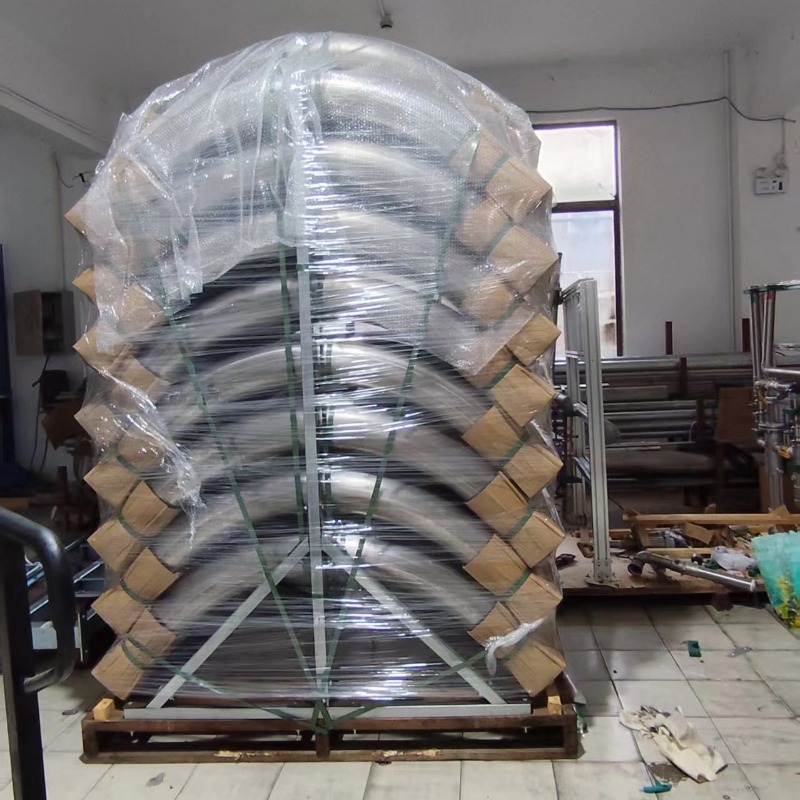
We precision stretch bend profiles in 6063-T5, 6061-T6 and 6082-T6, with walls from 0.8 to 6 mm, to a bending error of ±0.4 mm and flatness of 0.1–0.5 mm, in arc forms from conventional to fixed-radius, large-radius and multi-segment, in lengths up to 6,500 mm.
What actually happens to the stress
In roll bending, the profile is bent back and forth between rolls with decreasing amplitude. Each pass leaves its own stress pattern, and the final state is a complex distribution that depends on the number of passes, the roll settings and the material. It is not random, but it is not simple either.
In stretch bending, the section is gripped at both ends and pulled until the whole cross-section is above yield, then wrapped to the form. Because the entire section is plastic, the deformation is uniform through the thickness, and when the load is released the elastic recovery is also uniform.
The result is a residual stress pattern that is simple and predictable:
| Region | Residual stress after stretch bending | Konsequenz |
|---|---|---|
| Outer fibre of the bend | Druck | Favourable for fatigue; resists crack initiation |
| Inner fibre of the bend | Zug | Unfavourable, and concentrated at the inner radius |
| Through the thickness | A smooth gradient, not a series of bands | Predictable movement when machined |
| Along the length | Relatively uniform | The part does not develop a wave after machining |
So the honest statement is: stretch bending produces a uniform, predictable stress state rather than a complex one. For a precision part, that is what you want, because it can be accounted for. It is not the same as "no stress".
Why that matters for a machined part
If a bent profile is then machined — faces milled, holes bored, ends trimmed — the machining removes material and releases the stress in the removed layer. The part moves toward a new equilibrium.
With a complex residual pattern, the movement is unpredictable: it depends on which side is machined first and how much is removed, and two nominally identical parts can move differently. With a uniform pattern, the movement is predictable and can be compensated by leaving machining stock and taking a finishing pass after the part has relaxed.
This is the real argument for stretch bending in precision work, and it is a machinability argument rather than a strength argument.
The tolerance chain in precision stretch bending
Four things set the final accuracy, and only one of them is the machine.
The form. The die or the programmed path defines the target shape. On a fixed-radius form, the die profile is the reference. On a CNC machine, the path is — and the path is only as good as the model behind it.
The pre-stretch. The tension has to be high enough to put the whole section into plastic flow, and reproducible from part to part. If the tension varies, the springback varies, and the radius drifts.
Grip slip. If the material slips in the jaws during forming, the effective stretch is less than intended and the part comes out with a radius that does not match the setting. On a hard, smooth extrusion this is a real risk, and it is why jaw design and surface condition matter.
Material batch. Yield strength varies between heats. Since the pre-stretch is set relative to yield, a batch with higher yield behaves differently at the same setting. This is the source of the drift that shows up mid-run.
The ±0.4 mm bending error is held by controlling all four, and by checking the first piece and the last piece of each lot rather than assuming the middle follows.
Do not straighten a stretch-bent part
This is worth stating plainly because it is a common and expensive mistake. If a stretch-bent part is out of tolerance, the instinct is to correct it in a press or a straightener. Doing that destroys the very property you chose the process for: the uniform stress state becomes a local one, and the part's subsequent behaviour becomes unpredictable.
There is also a mechanical risk. Stretch bending has used part of the material's elongation reserve. A correction pass adds more strain in a local region, and that region may crack.
If a stretch-bent part is out, the answer is to re-form it from a new piece, or to accept it if the deviation is within what the assembly can absorb. Correcting it is not a repair; it is a different, worse part with the same serial number.
Spezifikationen
| Element | Referenzwert |
|---|---|
| Prozesse | Stretch bending, roll bending, press bending |
| Legierungen | 6063-T5, 6061-T6, 6082-T6 |
| Arc forms | Conventional arc, fixed radius, large radius, multi-segment |
| Wandstärke | 0.8–6 mm |
| Biegefehler | ±0.4 mm |
| Ebenheit | 0.1–0.5 mm |
| Maximum formed length | 6,500 mm |
| Extrusion length available | up to 20 m |
| Ausrüstung | CNC stretch bending machines, roll benders, CNC bending machines |
| Nachgelagert | CNC-Fräsen, Bohren, Gewindeschneiden, Schneiden, Schweißen |
| Oberflächenbehandlung | Eloxieren, Harteloxieren, Pulverbeschichtung |
| Standard | GB/T 6892-2023, ISO 9001 |
The three processes, on the criteria that matter
| Streckbiegen | Rollbiegen | Press bending | |
|---|---|---|---|
| Forming | Tension plus forming die | Continuous roll feed | Fixed-point angle forming |
| Arc uniformity | Hoch | Relatively high | Allgemein |
| Section deformation | Small; tension holds the shape | Mäßig | Larger at each bend point |
| Oberfläche | No press marks, no scratches | Slight roll marks | Bend marks at each point |
| Residual stress | Uniform and predictable | Complex, pass-dependent | Localised at each bend |
| Enden | Accurate, no straight run-out | Straight run-out | Accurate |
| Am besten für | Precision arcs and rings | High-volume equal-section arcs | Frames and bracket corners |
Wo es nicht passt
- The part is a tight radius on a heavy wall. Stretch bending still has a strain limit; it does not make an impossible radius possible. Check the strain calculation first.
- The part has to close a ring and the residual stress matters to a subsequent weld. Welding a stretch-bent part adds its own stress pattern on top, and the two interact. Consider stress relief before welding.
- The section is thin-wall and hollow with no internal support. Tension helps hold the shape but does not prevent collapse at a tight radius. A mandrel or filler is still needed.
- The part will be anodised and the outside of the bend is Class A visible. Stretch bending avoids press marks, which is its advantage, but flow lines can still show after anodising.
- The quantity is one or two and the form is custom. A forming die and a trial piece are a real setup. For a couple of parts, a roll-bent arc may be adequate.
- The design needs an angle, not an arc. That is press bending or a welded corner.
Was für ein Angebot zu senden ist
Send the section drawing, the arc geometry with radius and arc length, the alloy and temper, the quantity, and whether the part will be machined after forming. If it will be machined, say which faces — the residual stress pattern is uniform, so the machining sequence can be planned around it, but that has to be decided before the parts are made.
We will reply with the pre-stretch approach, the die or path, the achievable radius and flatness, the tolerance we can confirm, and the machining sequence if the part is to be machined afterwards. If the radius is beyond the material, that goes in the reply rather than in a cracked first article.
FAQ
What accuracy can you hold in precision stretch bending?
Reference ±0.4 mm on the bend geometry and 0.1–0.5 mm flatness, over lengths up to 6,500 mm. Those are capability references: the value on your order is set by your drawing, and on a precision part we also agree the measurement condition, because the part is checked against a template or a CMM program rather than by eye. We confirm both in writing before you order.
Does stretch bending eliminate residual stress?
No, and it is worth being precise about it. It replaces a complex, pass-dependent pattern with a uniform and predictable one: compression on the outer fibre, tension on the inner, with a smooth gradient through the thickness. That is why a stretch-bent part machines predictably. A part with no residual stress at all would require a stress relief after forming.
Why use stretch bending instead of roll bending for a precision part?
Three reasons. The tension holds the section shape, so distortion is small. There is no straight run-out at the ends, so a ring can close. And the residual stress is uniform, so a subsequent machining operation moves the part predictably rather than unpredictably.
Can a stretch-bent part be straightened if it is out?
No — that is the one thing not to do. Straightening destroys the uniform stress state and may crack a section that has already used part of its elongation. Re-form the part, or accept it if the assembly can absorb the deviation.
Can the part be machined after forming?
Yes, and it is better behaved than a roll-bent part because the stress is uniform. Plan the sequence: rough machine, allow the part to relax, then finish machine. That is a decision to take at quotation, because it affects the tolerance you can hold on features near the bend.
What happens with a batch of mixed material?
Yield strength varies between heats, and the pre-stretch is set relative to yield, so a batch with higher yield behaves differently at the same setting and the radius drifts. We check the first and last piece of each lot for that reason, and if the material certificates show a wide spread we may set the process per lot rather than once.
Wie wird es kalkuliert?
On the section, the arc, the length and the quantity, with the die or the programming as a setup. Precision work means a trial piece and a check, which is real time. It is priced per part rather than per metre, because the accuracy comes from the checking, not from the forming.
Senden Sie Ihre Zeichnung
Email the section drawing, the arc geometry, the alloy and whether the part will be machined afterwards to linjunbing@truetrustlv.com, or send it on WhatsApp at +86 136 6644 0600. You will get a pre-stretch approach, a machining sequence if relevant, and a written tolerance statement.
ANGEBOT ERHALTEN
Sobald Sie Ihre Anforderungen übermittelt haben, kontaktieren wir Sie so schnell wie möglich bezüglich Ihrer Produktanfrage.:Präzisions-Streckbiegen – gleichmäßige Spannung und enge Bögen