
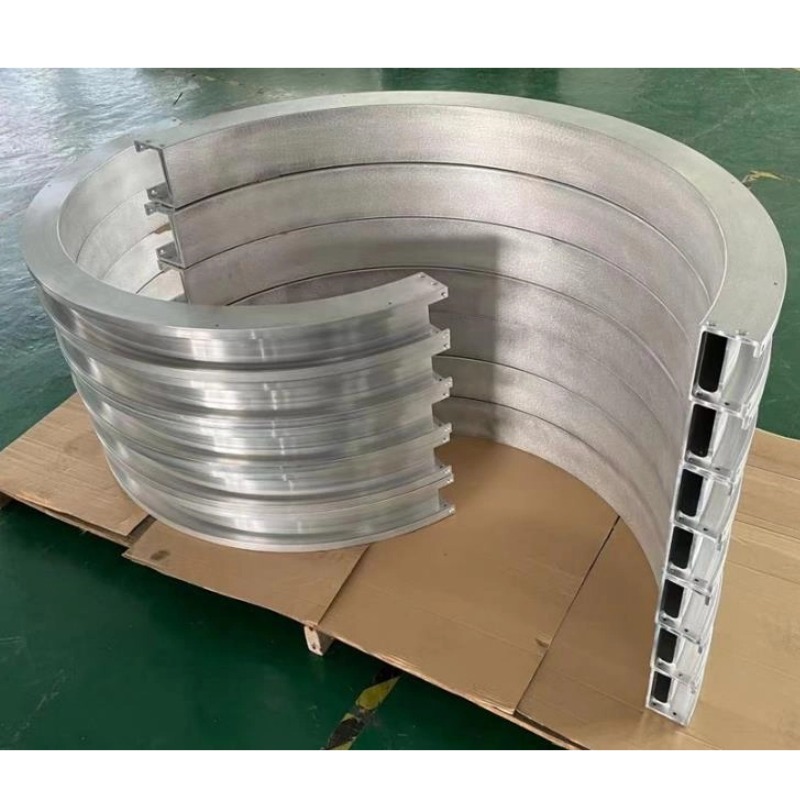
Aluminum Profile Bending
Tube Roll Bending - Ovality Control and Mandrels
Tube bending with ovality control: R/D ratio, ball mandrel, wall thinning 5-15%, weld seam positioned near the neutral axis, ±0.4 mm.
Produktdetails
A tube is not a solid bar and it is not an open profile. It is a closed thin shell, and the way it fails in bending is specific to that: the section ovalises. The top and bottom walls move toward each other, the sides bulge out, and a tube that measured round on the straight is visibly out of round at the bend.
We roll bend round tube, square tube and rectangular tube in 6063-T5, 6061-T6 and 6082-T6, with a reference bending error of ±0.4 mm and a controlled ovality. Here is what governs the result, and where the weld seam has to go.
Ovalisation: the defect that defines tube bending
When a tube bends, the outer wall is stretched and pulled inward, and the inner wall is compressed and pushed outward. Both movements act to flatten the section in the plane of the bend. The result is an ellipse: the dimension in the plane of the bend decreases, and the dimension perpendicular to it increases.
Ovality is usually expressed as a percentage: the difference between the maximum and minimum diameter at the bend, divided by the nominal diameter. A tube that is 50 mm round and measures 48.5 in one direction and 51.2 in the other has about 5 percent ovality.
Two ratios control how much you get:
| Ratio | What it means | Effect on ovality |
|---|---|---|
| R/D — bend radius over tube diameter | How tight the bend is | Smaller R/D, much more ovality. Below R/D = 2 it becomes severe |
| t/D — wall over diameter | How stiff the shell is | Thicker wall resists ovalisation; a thin wall at a tight radius is the worst case |
As a working guide: at R/D above about 3 and a normal wall, ovality without internal support can be kept to a few percent. Between R/D 2 and 3, support is usually needed. Below R/D 2, a mandrel is mandatory and even then the ovality is significant.
Why it matters depends on the application. A structural tube with 4 percent ovality is fine. A tube that has to pass an internal piston, carry a close-fitting insert, or be joined to a mating round part, is not — the oval section will not accept the part that was designed for a round one.
Mandrels, and what each one does
Internal support is the main tool against ovalisation. Three types, in order of how much they control:
Plug mandrel. A fixed plug positioned at the tangent point of the bend. It prevents the inner wall from wrinkling and reduces ovality. It is simple and it works on moderate bends. It does not support through the bend, so the ovality is lowest at the start of the bend and worst at the end.
Ball mandrel. A series of balls on a flexible link, positioned through the bend. It supports the whole bend length, so ovality is controlled throughout. This is the standard for tight radii and thin walls. It needs the tube end to be open for withdrawal, and the balls leave a faint track on the inner surface.
Flexible mandrel or filler. For shapes where a rigid mandrel cannot be withdrawn — a bend near a closed end, or a compound curve. Low-melting filler or an elastomer is used, with a melt-out or extraction step afterwards.
The mandrel is not free. It adds setup time, it needs the tube length to include a grip allowance that is cut off, and it can mark the bore. On a part where the bore is functional, that trade has to be considered.
The weld seam: where it goes decides whether the bend survives
This is the point most often missed on welded tube, and it is worth being precise.
A welded tube has a longitudinal seam. In bending, the outer wall is in tension and the inner wall is in compression. The seam is the weakest line in the wall for both:
- On the outer wall, the seam is in tension across its length, and any incomplete fusion or undercut becomes a crack starter.
- On the inner wall, the seam is in compression and tends to open or wrinkle.
So the seam should be positioned near the neutral axis — at roughly 90° to the plane of the bend, within about ±45°. There it sees little tension or compression, and the bend proceeds without opening it.
In practice this means the tube has to be oriented before bending, and the orientation has to be maintained through the pass. On a roll bender that is a setup discipline; on a CNC bender it is a programmed feature. Either way, ask the question: which way is the seam facing when the bend is made?
If the seam cannot be positioned — because the part has bends in more than one plane — then the material choice matters. A seamless tube removes the problem at a cost premium, and it is the right answer for a multiaxis bent part in a pressure or fatigue application.
Spezifikationen
| Element | Referenzwert |
|---|---|
| Prozess | Tube roll bending and stretch bending |
| Querschnitte | Round tube, square tube, rectangular tube |
| Legierungen | 6063-T5, 6061-T6, 6082-T6 |
| Biegefehler | ±0.4 mm |
| Ovality, with mandrel | Controlled; stated per part at quotation |
| Internal support | Plug, ball mandrel, or melt-out filler |
| Wall thinning, outer fibre | Typically 5–15%, higher at small R/D |
| Weld seam orientation | Near the neutral axis, within ±45° of it |
| Maximale Länge | up to 20 m, subject to the bend |
| Interne Unterstützung | Extrusion, die design, CNC machining, welding |
| Oberflächenbehandlung | Eloxieren, Harteloxieren, Pulverbeschichtung |
| Standard | GB/T 6892-2023, ISO 9001 |
Tube bending against profile bending
| Profile (open section) | Tube (closed section) | |
|---|---|---|
| Dominant defect | Flange wrinkling, twist | Ovalisation, inner wall wrinkling |
| Support needed | Pressure pad on the flange | Mandrel inside the bore |
| Wall change | Outer thins, inner thickens | Outer thins, section flattens |
| Weld seam | Not applicable | Critical: must be near the neutral axis |
| Joining after forming | Easy to access both sides | Access limited; needs a sleeve or a fitting |
Wall thinning on the outer fibre
The outer wall of a bend stretches, so it thins. The amount is typically 5–15 percent, and it grows as the bend tightens relative to the diameter and as the wall gets thinner. On a pressure-carrying tube this is a strength reduction at the point of highest bending stress, and on a part with a threaded end near the bend it can be the difference between a sound thread and a stripped one.
The thinning is predictable from the geometry, and it should be measured on the first article at the point of maximum bend, not on a straight section. If a drawing specifies a minimum wall after forming, that requirement has to be quoted against, because it may force a thicker starting tube.
Wo es nicht passt
- R/D is below about 1.5. Ovalisation and inner wrinkling cannot be controlled even with a mandrel. A formed fitting or a welded elbow is the right answer.
- The tube is welded and the seam cannot be oriented to the neutral axis. The seam will be in tension or compression at the bend. Use seamless tube, or change the bend layout.
- The bore has to stay perfectly round for a piston or a close-fit insert. Any bending ovalises it. Bore it after forming, or design the mating part to accept the ovality.
- The bore is a pressure boundary and cannot be marked. Mandrels mark the bore. If the mark is unacceptable, a filler is the alternative and it costs a per-part step.
- The tube is thin-wall and the radius is large. Ovality is modest but the tube is flexible, so it sags and the straightness between bends suffers. Support along the length during forming.
- The part must be joined to another tube by a slip fit after bending. The ovality will prevent the fit. Join before bending, or machine the ends round afterwards.
Was für ein Angebot zu senden ist
Send the tube drawing with the outside diameter and wall thickness, the bend geometry with centreline radius, whether the tube is welded or seamless and where the seam is, the quantity, and the ovality acceptance if you have one. Tell us what the bore does — if something has to pass through or fit inside, that sets the ovality limit far more tightly than a general tolerance.
We will reply with the R/D ratio, the expected ovality with and without a mandrel, the wall thinning to expect, the seam orientation we would use, and the tolerance we can confirm. If R/D is below what the wall will take, that goes in the reply.
FAQ
What bending accuracy and ovality can you hold?
Reference ±0.4 mm on the bend geometry, with ovality stated per part rather than as a blanket figure, because it depends on R/D and on the wall. Those are capability references: the value on your order is set by your drawing, and we confirm in writing what ovality and what wall thinning your specific tube will see before you order.
What causes the tube to go oval?
The geometry of bending a closed shell. The outer wall is pulled inward and the inner wall is pushed outward, so the section flattens in the plane of the bend. The amount depends on how tight the bend is relative to the diameter (R/D) and how stiff the wall is (t/D).
Do I need a mandrel?
Depends on R/D. Above about 3, a normal wall usually bends acceptably without one. Between 2 and 3, support is normally needed. Below 2, a ball mandrel or a filler is mandatory. We will tell you which applies to your tube rather than assume the worst.
Where should the weld seam be?
Near the neutral axis — at about 90° to the plane of the bend, within ±45°. There the seam sees little tension or compression. On the outer wall it is in tension and any incomplete fusion becomes a crack starter; on the inner wall it is in compression and tends to open. If the part has bends in more than one plane and the seam cannot be positioned, use seamless tube.
Does the wall get thinner?
Yes, on the outside of the bend, typically 5–15 percent depending on R/D and the starting wall. It is highest at the tightest part of the bend. If your drawing specifies a minimum wall after forming, tell us, because it may require a thicker starting tube.
Can square and rectangular tube be roll bent?
Yes, with a caveat: a square tube bends about one axis at a time and the corners resist ovalisation, but the flat walls can buckle inward if the bend is tight relative to the wall. The mandrel for a square tube has to match the bore shape, so tooling is more specific than for round tube.
Wie wird es kalkuliert?
On the tube size, the wall, R/D, the number of bends and the quantity. A mandrel adds setup and a grip allowance; a tight bend adds machine time and scrap risk. The price reflects the tooling and the time, which is why a simple large-radius bend and a tight mandrel bend of the same length are not priced alike.
Senden Sie Ihre Zeichnung
Email the tube drawing, the bend geometry, whether the tube is welded or seamless, and what the bore has to accept to linjunbing@truetrustlv.com, or send it on WhatsApp at +86 136 6644 0600. You will get the R/D assessment, the expected ovality and a written tolerance statement.
ANGEBOT ERHALTEN
Sobald Sie Ihre Anforderungen übermittelt haben, kontaktieren wir Sie so schnell wie möglich bezüglich Ihrer Produktanfrage.:Tube Roll Bending - Ovality Control and Mandrels