
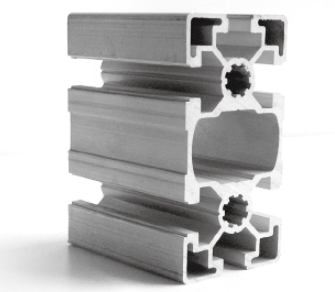
Industrial aluminum profiles
10-4590 T-Slot Aluminum Profile - 45 x 90 mm, 10 mm Slot
10-4590 profile: 45x90 mm, 10 mm slot, 6063-T5, 3.0 mm wall, 4.50 kg/m, I 58.00 cm4 on 90 mm axis. Longest span stocked. Per drawing.
Produktdetails
Kurze Antwort: 10-4590 is a 45 × 90 mm rectangle in the 10-series: 10 mm slot, 6063-T5, 3.0 mm wall, 4.50 kg/m, with 58.00 cm⁴ on the 90 mm axis and 15.50 cm⁴ on the 45 mm axis. It is the highest-span stocked section, 49 percent stiffer than 8-4080. The cost is the system change: a 10 mm slot, heavier fittings and a second hardware family. Section and tolerance are set by your drawing.
Wofür es verwendet wird
It carries the longest cross members in a profile-built frame: conveyor bridges over a walkway, gantry beams across a machine, overhead rails for a light lifting device, and structural beams where the span is fixed by the building or the process rather than by the frame design.
It is also used where a single beam has to carry a concentrated load at the middle rather than a distributed one, because the deeper section resists the local bending better than a shallower one of the same weight.
The class it belongs to is the top of the range. Above this, an aluminum profile is no longer the right material and the answer is a steel beam or a truss. Below it, 8-4080 covers most cases at a lower weight and within the 8-series system.
Spezifikationen
| Element | Wert | Hinweis |
|---|---|---|
| Querschnitt | 45 × 90 mm rectangular | 10-series, 10 mm slot |
| Legierung und Härtezustand | 6063-T5 | Standard für den Bereich |
| Wandstärke | 3.0 mm | |
| Gewicht | 4.50 kg/m | 61 percent above 8-4080 |
| Moment of inertia, 90 mm axis | 58.00 cm⁴ | 1.49 times 8-4080 |
| Moment of inertia, 45 mm axis | 15.50 cm⁴ | Above 8-4040 |
| Deflection, 1 m, 10 kg, strong axis | About 0.05 mm | Eigengewicht ausgeschlossen |
| Nutbreite | 10 mm | 10-series fittings, heavier brackets |
What it costs to move to the 10-series
The stiffness gain is real but the system change is the bigger decision. At 58.00 cm⁴ against 39.00 for 8-4080, the 4590 is 49 percent stiffer for 61 percent more weight. That is a slightly worse return per kilogram than the 8-4080, and it is not the reason people buy it. They buy it because they need the span and the 8-series has run out.
The 10 mm slot brings heavier connections. That is a genuine advantage on a long beam, because the end moment has to go somewhere and a heavier bracket with larger bolts can take more of it. On a beam that spans 3 m, the connection is often the governing detail, and a 10-series connection is better suited to it than an 8-series one.
But it also means a second hardware family. A frame that uses 8-series for the structure and 10-series for one beam needs two sets of nuts, brackets and drawings. In a workshop that is a real cost in mistakes as well as in inventory. The usual sensible pattern is to use the 10-series for the whole structural frame and the 8-series nowhere, or the reverse, rather than mixing per member.
And the weight is a handling question. At 4.50 kg/m, a 3 m beam is over 13 kg. That is manageable but it changes how the frame is assembled and moved, and on a machine that is built in a workshop and shipped assembled, the total mass matters for transport and for the floor it stands on.
Wo dies passt
It fits when a span cannot take a mid-support, when 8-4080 is not stiff enough, when the whole frame is already 10-series, and when the end connections need the heavier hardware.
Wo es nicht passt: if an 8-series frame is already designed, introducing this for one beam is rarely worth the second hardware system. If the span is beyond about 4 m, a steel beam will be lighter and stiffer than any profile. And if the beam is loaded sideways as well as vertically, the 45 mm axis at 15.50 cm⁴ is the limit and a square section may be safer.
Three things to get right
The connection is the design. A 58 cm⁴ beam delivers a substantial moment into its supports. A bracket that was adequate on a 4040 frame will not be adequate here, and the failure will look like excessive deflection rather than a joint problem. On a long beam, expect a side plate, a gusset or a double bracket, and design it with the section rather than after the frame is built.
Self-weight is a real part of the load. At 4.50 kg/m, a 4 m beam carries 18 kg of itself. On a long span that is a significant fraction of the total, and it cannot be reduced by changing the payload. If the deflection calculation was done on the payload alone, the real sag will be larger than expected.
Orientation is fixed by the section. With a 3.74-to-1 ratio, the 90 mm dimension must be vertical for a beam. Fitted on its side, the 45 mm axis governs and the beam behaves like a much smaller section. On a beam this is easier to see than on a small member, but it still needs to be on the drawing.
And the correct comparison is not the next size up. When 8-4080 is not enough, the options are this section or a fabricated steel beam. A steel IPE of similar depth will be stiffer and often lighter for the same span, at the cost of weight in the connections and no slot system. On a long span that comparison is worth doing explicitly, because the aluminum advantage shrinks as the span grows.
Was für ein Angebot zu senden ist
- The span, the load and the deflection you can accept
- Whether the whole frame is 10-series or only this member
- End connection detail, or the bracket type you intend to use
- Cut length, machining and any end plates
FAQ
Welche Toleranz können Sie halten?
Cut length and machined features are held to the tolerance on your drawing, with ends cut square and true. The value on your order is set by your drawing. On a long beam, the cut squareness and the position of the end holes matter because both feed into the level of the far support.
How does it compare with 8-4080?
It is 49 percent stiffer on the strong axis, 58.00 against 39.00 cm⁴, for 61 percent more weight. So the 8-4080 is slightly more efficient per kilogram, and the 4590 is chosen when the extra stiffness is needed rather than for its efficiency.
Do I have to change all fittings?
For this member, yes: it has a 10 mm slot and takes 10-series nuts and brackets. That is why mixing series in one frame is usually avoided, and why the decision is better made for the whole frame.
How far can it span?
It depends on the load and the deflection limit. As a guide, at 100 kg at the centre a 3 m span gives roughly 7 mm before self-weight and a 4 m span roughly 17 mm. Beyond about 4 m a steel beam is usually the better answer.
Can it be used as a column?
It can, but a rectangle used as a column is orientation-sensitive and the 45 mm axis becomes the weak direction. For a column, 8-6060 or 10-9090A is the better shape because it is isotropic.
What is the advantage over steel?
The slot system, the corrosion resistance, no welding and no painting, and the ability to modify the frame on site. On pure stiffness per kilogram over a long span, steel wins, and the honest answer is that the profile is chosen for the system rather than for the last few percent of performance.
Nächster Schritt
Send the span, the load and the end connection detail. We will check the section and come back with a recommendation against your drawing, including whether a steel beam would serve you better.
E-Mail: linjunbing@truetrustlv.com | Anrufen oder WhatsApp: +86 136 6644 0600
ANGEBOT ERHALTEN
Sobald Sie Ihre Anforderungen übermittelt haben, kontaktieren wir Sie so schnell wie möglich bezüglich Ihrer Produktanfrage.:10-4590 T-Slot Aluminum Profile - 45 x 90 mm, 10 mm Slot