
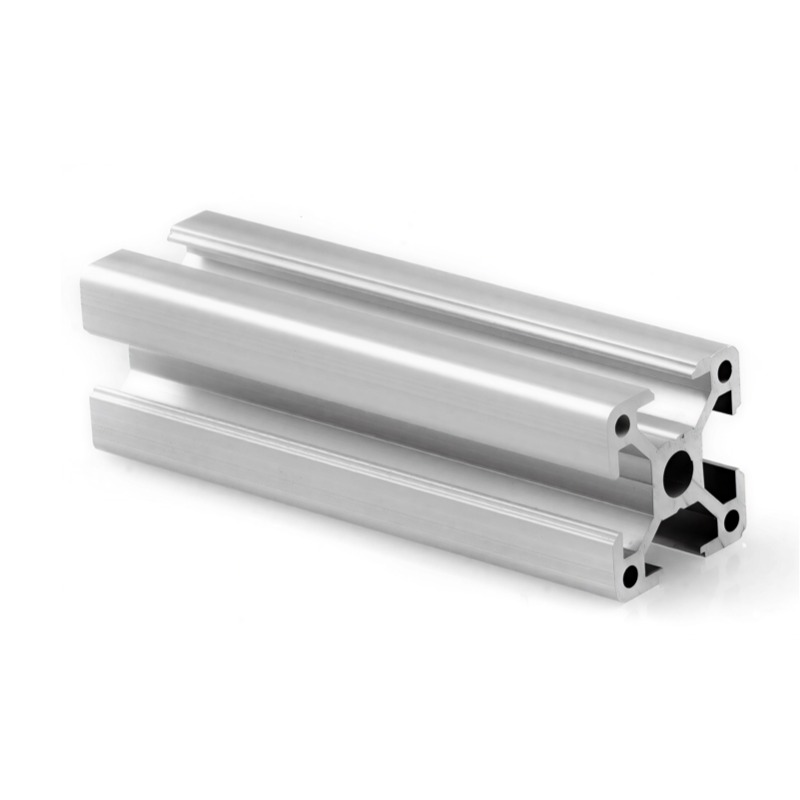
Industrial aluminum profiles
8-3030 T-Slot Aluminum Profile - 30 x 30 mm, 8 mm Slot
8-3030 profile: 30x30 mm, 8 mm slot, 6063-T5, 1.8 mm wall, 0.85 kg/m, I 3.20 cm4. 8 series fittings in a 30 mm envelope. Per drawing.
Produktdetails
Kurze Antwort: 8-3030 is the smallest square in the 8-series: 30 × 30 mm, 8 mm slot, 6063-T5, 1.8 mm wall, 0.85 kg/m, moment of inertia 3.20 cm⁴. Note that this is slightly less stiff than 6-2040 at 3.80 cm⁴, so nobody chooses it for stiffness. They choose it for the 8 mm slot in a 30 mm envelope, which means 8-series connections and M8 hardware on a small frame. Section and tolerance are set by your drawing.
Wofür es verwendet wird
It builds small frames that still have to take 8-series hardware: miniature machine guards, sensor and camera mounts, small test fixtures, light robot cell fencing, panel support in a tight envelope, and the sub-frame of an instrument that has to match an 8-series machine.
The usual reason is continuity. A machine is designed in 8-series, and a small sub-assembly has to bolt onto it. Using 8-3030 keeps one fitting system and one bolt size across the whole build, instead of introducing a 6-series island that needs its own brackets and its own nuts.
The other reason is floor space. When a frame sits between two machines separated by 300 mm, a 40 mm section may not fit, and 30 mm does.
Spezifikationen
| Element | Wert | Hinweis |
|---|---|---|
| Querschnitt | 30 × 30 mm square | 8er-Serie, 8-mm-Nut |
| Legierung und Härtezustand | 6063-T5 | Standard für den Bereich |
| Wandstärke | 1.8 mm | Thinner than 8-4040 |
| Gewicht | 0.85 kg/m | 41 percent of 8-4040 |
| Trägheitsmoment | 3.20 cm⁴ | Equal both directions |
| Nutbreite | 8 mm | 8-series fittings, M8 hardware |
| Deflection, 1 m span, 10 kg at centre | About 0.91 mm | Eigengewicht ausgeschlossen |
| Steifigkeit pro kg | About 3.8 cm⁴ per kg/m | Low for a square section |
What moving from 6-series to 8-series really costs
The section size is the smallest part of the change. Going from a 6 mm slot to an 8 mm slot changes the nut, the bolt, the bracket, the hinge, the corner connector and the cable clamp. None of the 6-series fittings fit an 8-series slot. So a designer who moves from 6-2040 to 8-3030 to gain a little stiffness has actually moved to a different hardware system, and the hardware list usually costs more than the profile difference.
What the move does buy is connection strength. An 8 mm slot takes M8 hardware and a heavier bracket, and the joint can transmit more moment before it slips. On a small frame carrying a vibrating device, that matters more than the section's own inertia. This is the honest case for 8-3030: not that it is stiffer, but that its joints are stronger than a 6-series joint of the same size.
The stiffness per kilogram is the weakest in the range. At about 3.8 cm⁴ per kg/m it is well below 8-4040 at 5.9 and far below 10-9090A at 14.7. Small square sections are inherently inefficient at buying stiffness, because inertia grows with the fourth power of size while weight grows with the square. So if stiffness is the goal, going up a size is always better value than staying small.
And the wall is the constraint on machining. At 1.8 mm there is limited material for a thread, so an end tap in 8-3030 is a thread in a thin wall. For a bracket-mounted joint that is fine; for a directly tapped joint that is opened repeatedly it is not. Where threads have to last, use a T-nut in the slot rather than a tap in the end.
Wo dies passt
It fits when a small frame has to integrate with 8-series equipment, when the envelope will not take 40 mm, and when the joints have to be stronger than a 6-series joint.
Wo es nicht passt: if the member has to carry load over a span, 8-4040 gives 2.66 times the stiffness for 70 percent more weight and is the better buy. If the frame can be entirely 6-series, staying in 6-series avoids a second hardware system. And if the frame is a structural element of a machine, 30 mm is simply too small regardless of the slot.
Wie es hergestellt wird
- The section is extruded in 6063 and cut to length, with the slot faces formed in the die rather than milled afterwards.
- Ends are cut square so a mitre or a butt joint closes without a gap, which matters more on a small frame where there is less length to absorb an error.
- Holes and taps are machined from one datum, generally the same face the frame is assembled against.
- Anodizing follows, with masking where a joint needs bare metal for electrical or structural contact.
- Finished parts are checked for length, squareness and slot condition, since a damaged slot face will not take a nut cleanly.
Was für ein Angebot zu senden ist
- The frame drawing or cut list with quantities
- Which members carry load, and the span
- Machining: end taps, cross holes, milled features
- Whether the frame must match an existing 8-series build
FAQ
Welche Toleranz können Sie halten?
Cut length and machined features are held to the tolerance on your drawing, with end cuts square so a mitred joint closes. The value on your order is set by your drawing, and on a small frame the accumulated length tolerance matters more than on a large one, because there is less room to absorb it at the joints.
Is 8-3030 stiffer than 6-2040?
No, and this surprises people. Its inertia is 3.20 cm⁴ against 3.80 for the 6-2040 on its strong axis, so the 2040 is stiffer in that direction. The 3030's advantage is the 8 mm slot and the stronger joint, not the section stiffness.
Why choose it over 8-4040?
Size and weight. It is 41 percent of the weight and 30 mm instead of 40. If the envelope allows 40 mm and the member carries load, the 4040 is the better engineering choice, and 3030 is for the case where space or visual weight rules it out.
Can I use 6-series fittings in an 8-series slot?
No. The slot widths and the nut geometries are different, and mixing them means a joint that does not seat properly. A frame that uses both series needs two hardware sets, which is why standardizing on one is usually cheaper.
Can the ends be tapped?
Yes, but the 1.8 mm wall limits the thread. For a joint that is assembled once, an end tap is fine. For a joint that is opened and closed, use a T-nut in the slot or a bracket, because a refreshed thread in a thin wall loses strength each time.
What finish is usual?
Clear anodizing, or black where the frame is visible. On a small frame that is handled during assembly, the anodized slot faces also resist the scuffing that would otherwise show.
Nächster Schritt
Send the frame drawing or cut list, with a note on which members carry load. We will cut and machine to your drawing and tell you if a member should be a size up.
E-Mail: linjunbing@truetrustlv.com | Anrufen oder WhatsApp: +86 136 6644 0600
ANGEBOT ERHALTEN
Sobald Sie Ihre Anforderungen übermittelt haben, kontaktieren wir Sie so schnell wie möglich bezüglich Ihrer Produktanfrage.:8-3030 T-Slot Aluminum Profile - 30 x 30 mm, 8 mm Slot