
Automated logistics
RGV-Bogenschiene – Biegeprozess und Rückfederung
Rollbiegen oder Streckbiegen entscheidet die Genauigkeit, bevor der erste Meter gebeugt ist. Rückfederung, Flankenverformung und warum 1000 mm eine Grenze und kein Ziel ist.
Produktdetails
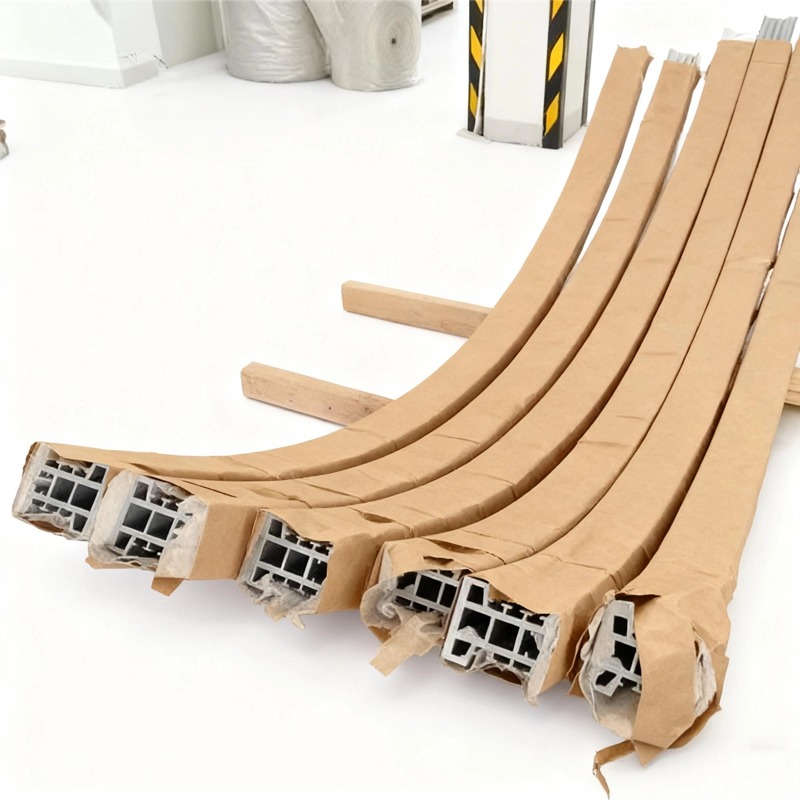
A curved RGV rail is not a straight rail that has been persuaded into an arc. It is a different manufacturing route with its own tooling decision, and the accuracy you can hold depends almost entirely on which route is chosen before the first metre is bent.
The main curved rail page deals with the vehicle dynamics — what centrifugal force does to the rail and the wheels. This page is about how the curve is actually produced: which process suits which radius, how springback is compensated, and what happens to the section on the inside of a tight bend.
Two processes, and they are not interchangeable
Rollbiegen passes the profile through three rolls and bends it progressively. It needs no dedicated tooling, so it suits any section and any radius above the machine's minimum, and it is economical for one-off curves and long sweeping arcs. Its weakness is control: the radius is set by roll positions and material response, so the operator converges on the target by measuring and adjusting, and the result is good but not perfectly repeatable from part to part.
Streckbiegen clamps both ends, pulls the profile in tension and wraps it around a form block shaped to the required radius. Because the whole section is in tension during forming, the material yields uniformly and springback is far more predictable. It holds a tighter tolerance and a more consistent arc, and it needs a dedicated form block per radius and per section — which is why it is used where the accuracy matters enough to pay for the tooling.
For RGV track the practical split is: sweeping curves above about 2.5 m radius are roll bent; tight curves below that, and any curve where the arc accuracy has to be better than about 0.5°, are stretch bent.
Spezifikationen
| Element | Referenzwert | Hinweise |
|---|---|---|
| Legierung und Härtezustand | 6063-T5 or 6061-T6 | T5 bends more easily; T6 holds shape better after forming |
| Bogengenauigkeit | Reference ≤ 0.5° | Angular deviation over the curved segment |
| Profile deviation | Reference ≤ ±0.4 mm | Maximum departure from the theoretical arc |
| Minimum radius | 1000 mm | Section-dependent; governed by R/H, see below |
| Curve types | S, circular, U, L | Compound curves need segment-wise tooling |
| Joint at tangent point | Reference ≤ 0.2 mm step | Straight-to-curve splice is the critical joint |
| Oberfläche | Hard anodised after bending | Coating before bending will crack at the outside of the bend |
Reference values are from shipped curves. The value on your order is set by your drawing, and we confirm the achievable arc accuracy and minimum radius in writing before you order.
Springback is predictable, and that is the whole point
Every bent aluminium section springs back when the load is released. The amount depends on the alloy, the temper, the ratio of bend radius to section height, and the section's own stiffness. For a typical RGV profile in 6063-T5, springback is in the range of 3 to 8 degrees of arc.
That is not a defect; it is a known quantity. The tooling is cut to an over-bent radius so that after release the section settles onto the target. The reason this matters to a buyer is that springback compensation only works if the section, the temper and the radius are fixed before the tooling is made. Change any of the three and the compensation is wrong.
This is where roll bending and stretch bending differ most in practice. Roll bending compensates by trial — the operator measures the first part and adjusts. Stretch bending compensates in the tool — the form block is machined to the corrected radius and every part comes off the same. For a project with twenty identical curves, stretch bending gives twenty identical curves; roll bending gives twenty curves each within tolerance but not identical to each other, which shows up as variation in the assembled track.
What happens to the section on the inside of the bend
Bending a hollow or open profile is a fight between two failure modes. On the inside of the bend the material is in compression and the wall wants to thicken and wrinkle. On the outside it is in tension and the wall wants to thin, and if the tension exceeds the material's ductility, it cracks.
Three things control which one wins:
- The R/H ratio. Radius divided by section height. Above about 10, both modes are mild and the bend is straightforward. Below 6, the inside wall starts to wrinkle on thin sections and the outside thins noticeably. At the 1000 mm minimum we quote, a 100 mm deep section is at R/H of 10 — comfortable — and a 150 mm deep section is at 6.7, which is where we start to recommend a different approach.
- The wall thickness. Thin walls wrinkle earlier. A 2 mm wall on a 100 mm deep section will buckle on the inside at a larger radius than a 4 mm wall on the same section.
- Whether the section is open or closed. An open section can be supported internally with a mandrel or a filler; a closed section needs the mandrel or it will collapse. Both can be bent, but the tooling cost differs.
The visible result of getting this wrong is a curve that measures within the arc tolerance but has a waved inside flange. The vehicle's guide rollers follow the flange, so a waved flange produces a lateral oscillation that no amount of arc accuracy fixes.
Why 1000 mm is a limit rather than a target
The minimum radius we quote is not a machine capability; it is the point where the section starts to distort beyond what the running face can tolerate. Below that radius the outside flange thins, the inside flange compresses, and the guide groove — which was extruded to a tolerance — goes out of tolerance in the bend.
If a layout needs a tighter turn than the section allows, there are three options and only one of them is good. The good one is to change the section to a shallower profile, which raises R/H and lets the same radius work. The second is to accept a larger radius and redesign the layout. The third — bending tighter and hoping the guide groove survives — is how a vehicle ends up derailing at one specific corner.
The straight-to-curve transition is the joint that matters
On a track with straights and curves, the joint at the tangent point is where the vehicle changes from running straight to running in an arc. It is also the joint where two different manufacturing processes meet, so it is the hardest to make seamless.
Two details make the difference. First, the tangent point should be machined after bending so that the curve's end face is square to the track direction at that point — a bent end is never exactly square, and a sawn end on a curve is square to the wrong plane. Second, the joint should not be at the exact tangent point if it can be avoided; it should be a short distance into the straight, where both faces are easier to control and where the vehicle is not simultaneously changing direction.
Wo es nicht passt
Four cases where we would advise against a bent aluminium curve. If the required radius is below about 800 mm on any section deep enough to carry an RGV, the distortion is not recoverable and a fabricated curve from cut and welded segments is the honest answer, with a machined running insert. If the curve is a full 180° or more in one piece, transport becomes the constraint before bending does. If the track has to be bent after anodising, the coating will craze on the outside of the bend. And if the layout is likely to change after the first build, roll bending is the better choice despite its variation, because it can be re-done without new tooling.
Was für ein Angebot zu senden ist
- The track drawing with radii, tangent points and the direction of the curve.
- The section drawing, or the guide groove dimensions if the section is fixed by the vehicle.
- The number of identical curves — this decides whether stretch bending tooling is worth building.
- Whether the curve will be anodised, and whether the anodising is before or after bending.
Send those and we can tell you which process we would use, what radius limit applies to that section, and where the joints should sit.
FAQ
Welche Bogengenauigkeit können Sie halten?
Reference 0.5° of arc and ±0.4 mm profile deviation, with 1000 mm minimum radius. On tight radii and deep sections those figures are held by stretch bending; on sweeping curves roll bending reaches the same tolerance but with more part-to-part variation. The value on your order is set by your drawing, and we confirm the achievable arc accuracy in writing before you order.
Can you bend a section you have not made?
Yes, if we can get the section or a sample. The tooling depends on the outside dimensions and the wall thickness, not on who extruded it. What we cannot do is guarantee the arc if the section's wall varies along the length, because the springback varies with it.
Why is my curve accurate but the vehicle still stutters?
Almost always the inside flange, not the arc. A waved or thinned inside flange makes the guide rollers oscillate even though the centreline is perfect. Check the flange profile with a straightedge across the bend, not just the arc with a template.
Sollte die Schiene vor oder nach dem Biegen eloxiert werden?
After. An anodic coating is brittle and will craze or crack on the outside of a bend. The exception is a very large radius on a flat section, where the strain is low enough that the coating survives — but it is not worth the risk on a functional running face.
How do you stop the section collapsing on a tight bend?
An internal mandrel or a low-melting filler. For open sections a mandrel supporting the web is enough; for closed sections the mandrel has to match the internal profile. This is one of the reasons tight bends cost more than sweeping ones.
Can I get a compound curve — a bend in two planes?
Only as a series of segments, each bent in one plane and joined. A true compound curve on an aluminium profile needs a dedicated forming setup and is rarely economic for track. If the layout needs one, it is usually better to re-plan the route.
Nächster Schritt
Send the track drawing with the radii and the section. We will come back with the process we would use, the radius limit for that section, and a joint layout that keeps the tangent points clean.
E-Mail: linjunbing@truetrustlv.com | Anrufen oder WhatsApp: +86 136 6644 0600
ANGEBOT ERHALTEN
Sobald Sie Ihre Anforderungen übermittelt haben, kontaktieren wir Sie so schnell wie möglich bezüglich Ihrer Produktanfrage.:RGV-Bogenschiene – Biegeprozess und Rückfederung