
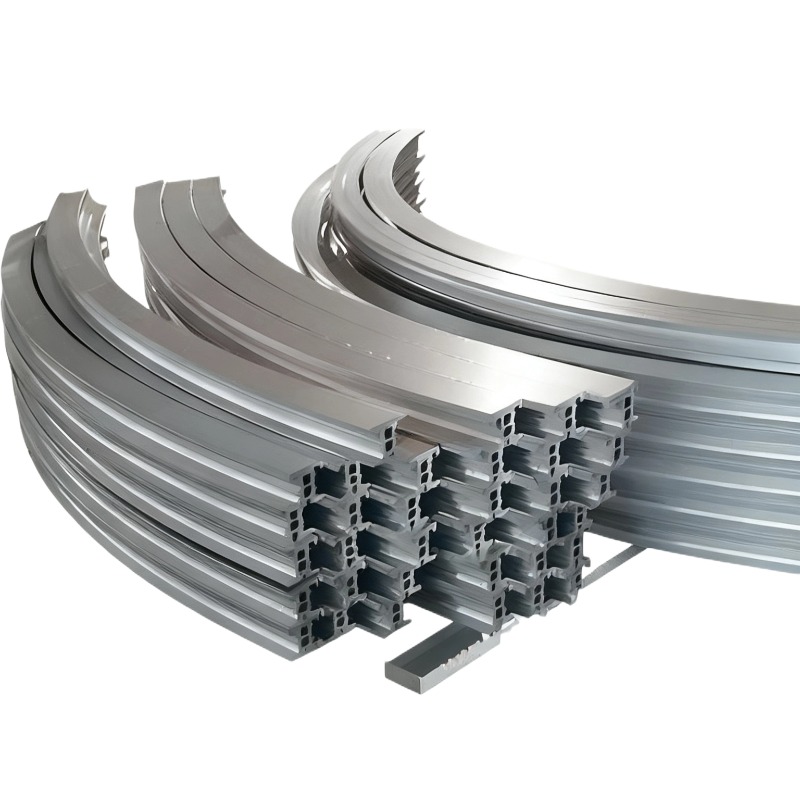
Automated logistics
Closed-Loop Ring Rail - Thermal Movement
A ring has no free end. Over 10 °C a 20 m loop grows 4.7 mm with nowhere to go. Support schemes that keep a closed track round.
Produktdetails
A straight rail has one problem a ring does not: it can grow. A closed loop cannot. Every metre of a ring is constrained by the metre on either side of it, so when the rail warms up, the extra length has nowhere to go except into the plane of the ring as a bow, or into the rail as compression.
The main ring rail page covers closure error and how tolerance is allocated backwards around the circuit. This page is about the other half of the same problem: the ring is a closed shape in a building that changes temperature, and that is a design condition rather than a tolerance.
Why a closed loop behaves differently
A 20 m straight run fixed at one end and free at the other grows 4.7 mm over a 10 °C rise, and nothing happens except that the free end moves. Fix both ends and the same 4.7 mm becomes compression, and the rail bows sideways.
A ring is the second case with no exception. There is no free end. If the supports hold the rail in plan, the thermal expansion becomes a compressive stress of roughly E times alpha times delta-T — about 16.5 MPa for 10 °C, and around 50 MPa for a 30 °C swing. Those are not trivial numbers against a 6061-T6 yield of 240 MPa, and they are present before the vehicle adds anything.
The visible result is not a crack. It is a ring that is round in winter and slightly square in summer, with the deviation concentrated between the fixed points and the vehicle developing a lateral force at the points where the curvature changes.
Spezifikationen
| Element | Referenzwert | Hinweise |
|---|---|---|
| Legierung und Härtezustand | 6063-T5 or 6061-T6 | 6061-T6 where the ring carries heavy shuttles |
| Closure error | Reference ≤ ±0.4 mm | Full loop, measured after assembly |
| Curvature accuracy | Reference ≤ 0.5° | Angular deviation over each curved segment |
| Joint quality | Flat running face, no step | Reference ≤ 0.1 mm step on a closed ring |
| Wärmeausdehnung | 23.6 µm per metre per kelvin | ≈ 4.7 mm on a 20 m ring over 10 °C |
| Support condition | One fixed point, rest sliding | Unless the ring is designed as a restrained structure |
| Surface at running face | Hard anodised | For high-cycle continuous circulation |
Reference values are from shipped loops. The value on your order is set by your drawing, and we confirm the achievable closure error and joint step in writing before you order.
The arithmetic, and why it is bigger than people expect
Aluminium expands by about 23.6 micrometres per metre per kelvin. A 20 m circumference ring therefore changes length by 4.7 mm over a 10 °C swing, and by 9.4 mm over 20 °C.
If that growth has to be accommodated by the ring changing radius while staying circular, the radius change is the length change divided by two pi — about 0.75 mm for the 10 °C case. That sounds harmless, and on a free ring it is: the ring simply becomes 0.75 mm larger in radius, uniformly, and the vehicle never notices.
The problem is that a ring on supports is not free. Rings are supported at discrete points, and each support is either fixed or sliding. With four fixed supports, the growth cannot distribute evenly; it accumulates in the arcs between supports and shows up as a local bow rather than a uniform radius change. On a 20 m ring with four supports, the movement between supports can be several millimetres — in the same direction and the same order of magnitude as the closure tolerance the ring was built to.
So the thermal movement is not a small correction on top of the accuracy. It is comparable to the accuracy, and it has to be designed rather than tolerated.
Three ways to let a ring breathe
There are three practical approaches, and they suit different installations:
- All supports sliding. The ring rests on sliding pads or rollers and is located laterally by guide rollers at one or two points only. The ring expands freely and stays circular. This is the cleanest solution and the one we recommend where the ring can be built as a self-supporting loop.
- One fixed point, the rest sliding. The ring is anchored at one place to set its position in the building, and allowed to move everywhere else. The expansion then appears as a small rotation and translation of the whole ring rather than as a bow. It requires the surrounding structure to tolerate that movement, which is usually fine over a few millimetres.
- An expansion joint. The ring is fixed at several points and one joint is designed to slide. This keeps the ring located but introduces a joint that opens and closes with temperature — and that joint is at the running face, which is the worst place for a moving discontinuity.
The third option is the one that gets chosen when the building constraint is rigid, and it is the one that causes trouble later. A sliding joint on a running face is a step that changes size with the season.
The joint and the expansion point fight each other
A closed ring has at least one joint, and the closure tolerance is measured there. If that same joint is also the expansion joint, it has two incompatible jobs: it has to be a precision interface for the running face and a sliding interface for thermal movement.
The way out is to separate them. Make the closure joint a permanent, dowelled, machined joint with a fixed step below 0.1 mm, and put the thermal freedom in the supports rather than in the rail. If a sliding joint is unavoidable, put it in a section the vehicle crosses slowly — a maintenance spur rather than the main running line — and accept a larger step there with a chamfer that the wheel can roll over.
Warehouse temperatures are not constant
The assumption that a warehouse is at a steady 20 °C is usually wrong in the ways that matter. A ring under a roof sees radiant heat from the roof deck in summer, which can put the rail 10 to 15 °C above the ambient air. A ring near a loading door sees cold air in winter. A ring in an unheated building in a cold climate can see a 40 °C annual swing, which is 19 mm of movement on a 20 m loop.
For the design what matters is not the average temperature but the range the rail sees between installation and the extremes of service. A ring installed in winter in an unheated building and then operated in summer will grow by the full annual range, and the installation clearance has to allow for it.
The practical step is to ask for the building's temperature range, not its set point, and to set the ring's position at the mid-point of that range so the movement is symmetric either way.
Wo es nicht passt
Four situations where a closed aluminium ring is the wrong choice. If the building has no temperature control and the loop exceeds about 40 m, the thermal movement becomes large enough that a steel ring with expansion joints is more predictable. If the ring has to be absolutely fixed in plan — for example where it registers against a fixed machine interface at several points — the thermal stress has to be absorbed by the structure and an aluminium ring with a rigid frame is the answer, not a free ring. If the vehicle load is above about 1.5 tonnes per position, the section needed for stiffness makes the ring heavy and hard to install in one piece. And if the ring is going into a washdown or chemically aggressive area, the hard anodised surface is the right finish but the sliding supports need to be specified for the same environment, or the freedom that the design relies on will seize.
Was für ein Angebot zu senden ist
- The loop drawing with the support positions and which of them can be fixed.
- The building's temperature range, including whether it is heated in winter and whether the ring sits under a roof deck.
- The vehicle weight, wheel arrangement and running speed.
- Whether the ring is a single loop or part of a multi-loop or S-shaped system, because the additional branches change the constraint.
Send those and we can tell you where the fixed point should be, which is the decision that determines whether the ring stays round.
FAQ
What closure error can you hold on a ring?
Reference ±0.4 mm on the full loop, with 0.5° curvature accuracy and a joint step under 0.1 mm. Closure is measured after assembly, because it depends on every segment in the loop rather than on any single one. The value on your order is set by your drawing, and we confirm the achievable closure in writing before you order.
Does the ring need expansion joints?
Only if the ring is fixed at several points. If the supports allow the ring to move, thermal expansion is absorbed without any joint. The question to ask first is how the ring is supported, not whether it needs a joint.
How much does a ring move over a year?
About 23.6 µm per metre per kelvin of the circumference. A 20 m ring in a building with a 30 °C annual swing moves about 14 mm in length. Whether that shows up as a bow depends entirely on how many points are fixed.
Can the ring be delivered in segments?
Yes, and above about 8 m diameter it usually has to be. Segments are joined on site with dowelled, machined joints, and the closure is set at the last joint. For a large ring we would rather supply a matched set with the joints numbered than individual bent sections.
Why does my ring go out of round in summer?
Because it is fixed at too many points. The expansion has nowhere to go, so the arcs between fixed points bow outwards. Converting some of the fixed supports to sliding supports usually fixes it without changing the rail.
Does hard anodising affect the closure?
Not the closure, but it affects the running face dimension. The coating adds roughly 25 to 50 µm per surface, so any machined slot or groove that has to accept a guide shoe must be dimensioned before anodising, not after.
Nächster Schritt
Send the loop drawing with the support positions and the building temperature range. We will come back with a support scheme that lets the ring move, a joint arrangement that keeps the running face flat, and the closure we can hold.
E-Mail: linjunbing@truetrustlv.com | Anrufen oder WhatsApp: +86 136 6644 0600
ANGEBOT ERHALTEN
Sobald Sie Ihre Anforderungen übermittelt haben, kontaktieren wir Sie so schnell wie möglich bezüglich Ihrer Produktanfrage.:Closed-Loop Ring Rail - Thermal Movement