
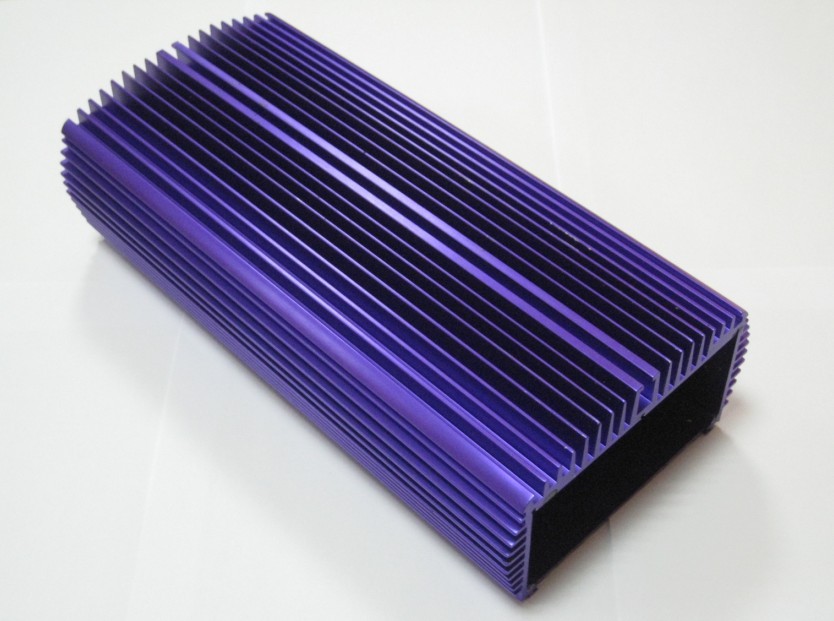
Aluminum product surface
Powder Coated Aluminum Profile
Powder coated aluminum profiles at 60-120 um, GB/T 9286 grade 1 adhesion and 500 h salt spray, full RAL range. Resin and masking agreed per drawing.
Produktdetails
Kurze Antwort: powder coating is an opaque, cured polymer film sprayed electrostatically onto the profile and baked on. We run 60–120 µm, hold adhesion at GB/T 9286 grade 1, and reach 500 hours of neutral salt spray, in any RAL or Pantone color. Two things decide whether it survives outdoors, and neither is the color: the resin system in the powder, and whether the threads and fits were masked before coating. Both are settled at quotation stage, and we confirm thickness and color against your drawing and your sample.
What the process actually does
Powder coating is not paint. The powder is a dry mixture of resin, pigment and additives, given a negative electrostatic charge and sprayed at a grounded profile. The charge holds it on the surface, the part goes into an oven, and the powder melts, flows and cross-links into a continuous film. There is no solvent to evaporate, which is why the process emits almost no VOC and why the film can be built to 100 µm in one pass without runs or sags.
The consequence that matters commercially is that the film is opaque. Unlike anodizing, which is transparent and shows every die line and weld through the finish, powder coating covers them. A profile with visible extrusion marks or a repaired scratch can be brought to a uniform appearance, which is the main reason powder coating is chosen for housings and frames that have to look clean rather than machined.
The consequence that matters technically is that the film is thick. At 60–120 µm it is roughly ten times the thickness of a decorative anodized layer, so it stands off the surface, blunts edges and fills threads. That thickness is the source of both its impact resistance and its dimensional problems: any feature that has to assemble to something else must be masked, and no amount of care afterwards will recover a thread that was coated.
Spezifikationen
| Element | Bereich |
|---|---|
| Prozess | Spray pre-treatment, electrostatic powder spraying, high-temperature curing |
| Coating thickness | 60–120 µm overall; 80–120 µm on flat faces, minimum 60 µm at edges and corners |
| Adhesion | GB/T 9286 grade 1, no detachment on cross-cut |
| Impact resistance | 1 kg·cm forward impact without cracking or detachment |
| Neutral salt spray | ≥ 500 hours without substrate corrosion |
| Color difference | ΔE ≤ 1.5 within a batch |
| Color range | Full RAL and Pantone, or matched to a physical sample |
| Glanz | Matte 25–35%, semi-gloss, high-gloss 75–85% |
| Surface effects | Smooth, textured, hammer-tone, wrinkle, metallic, pearlescent |
| Legierungen | 6063-T5, 6061-T6 and other wrought profiles |
| Maximale Teilelänge | 6,500 mm |
| Referenznorm | GB/T 5237.4-2017 |
| Prüfung | Thickness and adhesion per batch; salt spray and color difference reports on request |
The resin question, which decides everything outdoors
Two powders can produce identical-looking parts on the day of delivery and behave completely differently two years later. The difference is the resin system, and it is not visible in the finish.
- Polyester powder. The standard choice for outdoor aluminum. It holds color and gloss under UV for years, and it is what architectural and exterior equipment work should specify.
- Epoxy powder. Chemically tougher and cheaper, with excellent adhesion, but it chalks and fades under sunlight. It belongs indoors, on machine frames and internal housings, and putting it outside is a mistake that only shows up after the first summer.
- Epoxy-polyester hybrid. A compromise for interior parts where some chemical resistance is wanted. Not an exterior finish.
If a project is going outdoors and the powder is not specified, ask what resin it is. A quoted 500-hour salt spray result tells you about corrosion, not about UV, and the two failures look nothing alike: corrosion appears as blistering from the edges, UV breakdown appears as a chalky, washed-out surface that wipes off on your hand.
Where the film is thinnest, and why it matters
An even 100 µm everywhere is not what electrostatic spraying actually produces. The charge concentrates on the outermost, most exposed surfaces, so flat faces and outer corners build thickness quickly, while recessed areas, internal corners and the inside of a channel run thinner. That is why the specification is written as 80–120 µm on flat faces with a 60 µm minimum at edges: the minimum is there to catch the places the spray reaches last.
For a buyer, the practical consequence is that the inside of a deep channel is where corrosion starts, not the outside face. If a profile has deep grooves that will be exposed to weather or washdown, say so on the drawing, because those areas need a second pass rather than the standard one. On a shallow open section the standard process is enough.
Masking: the step that is decided before coating
Anything that has to assemble after coating has to be masked before it. At 60–120 µm, a coated M6 thread will not accept its nut, a coated bore will not accept its shaft, and a coated earth point will not conduct. Masking is cheap; re-cutting a thread through cured powder is not, and it leaves the thread bare and unprotected anyway.
Send the drawing with the masked areas marked. Typically that means threads, dowel holes, mating faces, hinge bores and electrical contact points. If the drawing does not mark them, the coating will go everywhere, and the parts will need rework.
Choosing a finish
| Finish | What it does | Where it is used |
|---|---|---|
| Matte, 25–35% gloss | Low glare, hides surface unevenness | Equipment housings, frames in lit spaces |
| Semi-gloss | Balanced; easier to clean than matte | General industrial covers |
| High-gloss, 75–85% | Reflective, shows every surface defect beneath | Consumer-facing products with sound substrates |
| Textured / wrinkle | Masks die lines and handling marks; thicker feel | Machine guards, tooling, outdoor cabinets |
| Hammer-tone | Breaks up large flat areas visually | Enclosures and doors |
| Metallic / pearlescent | Metallic depth without anodizing | Appearance parts; check UV rating of the effect pigment |
The general rule: the glossier the finish, the more the substrate has to be perfect. High-gloss on a profile with visible die lines reads as a defect, while the same profile in a textured finish reads as intentional.
Wo dies passt
- Housings, cabinets and machine covers where a specific brand color is part of the product
- Outdoor equipment and architectural profiles that need a durable color film
- Parts whose extrusion surface has marks that should not be visible after finishing
- Frames and structures where impact resistance matters more than a metallic look
- Any part that must match a RAL code held across a product family
Wo es nicht passt
- A part that has to look like metal. Powder coating is opaque plastic film; it will never read as anodized aluminum.
- Close-tolerance assemblies with no room for 60–120 µm. Every mating surface has to be masked, and if the drawing does not allow for that, the parts will not fit.
- Threads, bores and electrical contacts that cannot be masked at the drawing stage.
- Applications needing electrical conductivity or heat transfer through the coating, since the film insulates.
- Sharp-edged decorative trim, where the film pulls back at the edge and leaves a thin line of bare metal.
Was für ein Angebot zu senden ist
- The drawing, with masked areas marked: threads, bores, mating faces, earth points
- The color as a RAL or Pantone code, or a physical sample to match
- Whether the part goes outdoors, so the resin system can be specified
- The gloss level and surface effect you want
- Any area that will see weather, washdown or chemical exposure, especially deep recesses
- Menge und die längste Einzellänge, geprüft gegen die 6.500-mm-Grenze
If the color is only a photograph, send it anyway; matching to a physical sample is more reliable, and we will send a coated sample for approval where the color is critical.
FAQ
What thickness can you hold?
60–120 µm overall, with 80–120 µm on flat faces and a 60 µm minimum at edges and corners. The range is wide because electrostatic spraying is not uniform by nature, and the minimum is what protects the recessed areas. If you need a tighter band on a specific face, mark it on the drawing; as a reference we work to your drawing and confirm the achievable value before production.
Will the color match my RAL code exactly?
It will be close, and ΔE ≤ 1.5 within a batch is what we hold. Small differences between the code and the cured film are normal, because the powder, the substrate and the oven all shift the final tone slightly, and the same RAL number can differ between powder suppliers. For a brand color used across a product family, approve a coated sample first and keep it as the reference for repeat orders.
How long will it last outdoors?
That depends almost entirely on the resin, not the thickness. Polyester powder with a proper pre-treatment holds color and gloss for many years in normal exterior conditions. Epoxy powder, which looks identical on delivery, will chalk and fade within a couple of seasons. 500 hours of salt spray tells you about corrosion resistance; it says nothing about UV, so specify the resin if the part lives outside.
Can you coat over a weld or a repaired area?
Yes, and this is one of powder coating's real advantages: it covers welds, sanding marks and minor repairs that anodizing would leave visible. The weld has to be dressed and cleaned first, and the pre-treatment has to be right, or adhesion fails at exactly that spot. Tell us where the welds are so they get the attention they need.
What happens if a thread gets coated?
It will not assemble. At this film thickness a coated thread loses its fit entirely, and chasing it afterwards removes the coating and leaves bare aluminum that corrodes. This is why masking is specified at the drawing stage. Send the drawing with threads and fits marked and they are masked before the part enters the line.
Can you match a color on a short run?
Yes. Short runs are common for us, and the constraint is not the quantity but the color approval: a custom color needs a sample coated and approved before the batch, which adds a step. For a standard RAL from stock powder, that step is not needed.
Senden Sie Ihre Zeichnung
Email linjunbing@truetrustlv.com with the drawing, the RAL or Pantone reference and whether the part goes outdoors. If the color is only a photograph, send that too. You will get a process proposal, a quotation and the thickness we can hold — reviewed by an engineer, not an auto-reply.
WhatsApp: +86 136 6644 0600
ANGEBOT ERHALTEN
Sobald Sie Ihre Anforderungen übermittelt haben, kontaktieren wir Sie so schnell wie möglich bezüglich Ihrer Produktanfrage.:Powder Coated Aluminum Profile