
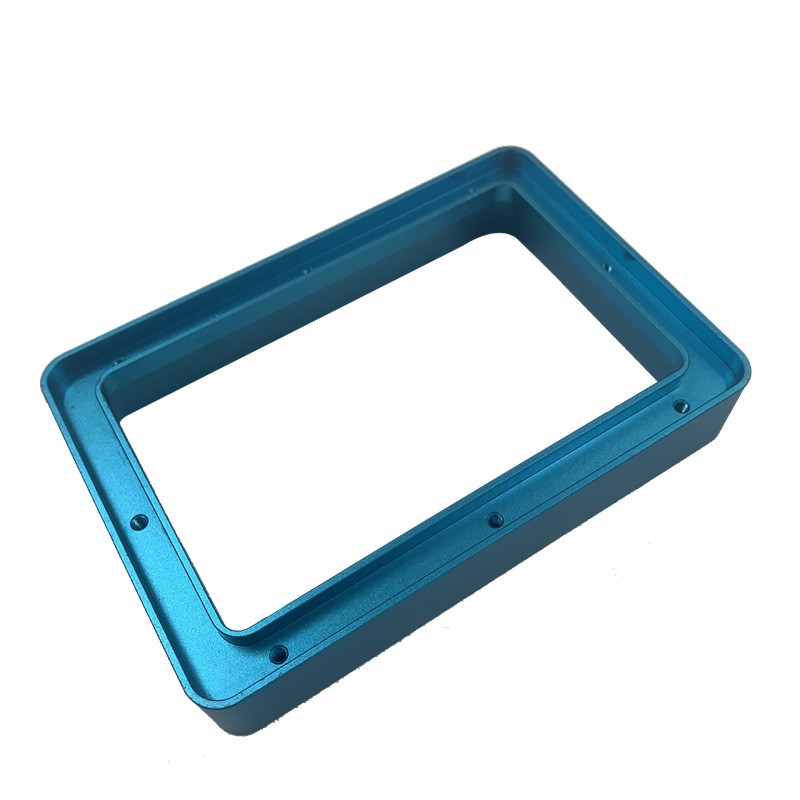
Aluminum product surface
Aluminiumprofile mit elektrophoretischer Beschichtung (E-Coat)
Elektrophoretische Beschichtung in 15-35 µm, 2H-4H, Adhäsionsgrad 0 und 1000 h Salznebel. Erreicht Hohlräume, die Besprühen nicht. Dicke nach Zeichnung vereinbart.
Produktdetails
Kurze Antwort: electrophoretic coating immerses the part in a water-based paint bath and uses direct current to deposit the film, which is why it reaches surfaces spraying cannot. We run 15–35 µm at 2H–4H pencil hardness, with cross-cut adhesion at grade 0 and neutral salt spray past 1,000 hours — three times ordinary anodizing, at roughly half the film thickness of powder coating. It is the right process for complex geometry and for protecting a polished surface, and the film thickness and color are confirmed against your drawing.
What e-coat does that spraying cannot
The difference is physical, and it explains most of the specification. Spray processes, including powder coating, need a line of sight: the charged particles travel from a gun to the surface, so a recess faces the gun and gets coated, while a cavity turned away from it does not. Charge also concentrates on exposed edges and outer corners, so spray builds thickness where it is easiest to reach and runs thin exactly where protection is needed.
E-coat does not spray. The part is submerged in the bath, and the paint particles are drawn to it by the electric field the part itself generates. The film deposits wherever current can flow, which includes the inside of a box section, the bottom of a channel, the walls of a blind hole and the full wrap of an edge. The film stops growing where it insulates itself, which is what makes the thickness self-limiting and uniform rather than operator-dependent.
For a simple flat panel, this advantage is worth little and powder coating is cheaper. For a machined housing with pockets, ribs, tapped bosses and sharp edges, it is the difference between a fully protected part and one whose corrosion starts in the corners the gun never reached.
Spezifikationen
| Element | Bereich |
|---|---|
| Prozess | Cathodic electrophoretic deposition, water-based paint, high-temperature curing |
| Schichtdicke | 15–35 µm, uniform across exposed and recessed surfaces |
| Glanz | 60–90%, high-gloss available for a mirror-like surface |
| Pencil hardness | 2H–4H |
| Adhesion | Cross-cut grade 0, no detachment |
| Neutral salt spray | ≥ 1,000 hours, over three times ordinary anodizing |
| Farben | Clear, black, white, silver, gold |
| Paint utilization | Over 90% |
| Legierungen | 6063-T5, 6061-T6 and other 6-series |
| Maximale Teilelänge | 6,500 mm |
| Pre-treatment | Degrease, rinse, phosphating or passivation, rinse |
| Prüfung | Thickness and adhesion per batch; salt spray on request |
Thinner film, better corrosion — why that is not a contradiction
It looks wrong at first. Powder coating is 60–120 µm thick and reaches about 500 hours of salt spray; e-coat is 15–35 µm and reaches over 1,000. Thickness is not the only thing that resists corrosion, and past a point it stops being the main thing.
What protects the metal is a continuous, pore-free barrier in intimate contact with the surface. E-coat deposits as a dense, cross-linked film that is driven onto the substrate by the current, so it starts at the metal and grows outward without the micro-voids and pinholes that a sprayed powder can trap. Powder coating compensates for its porosity with thickness. E-coat does not need to. The same reasoning applies to adhesion: a film bonded at the interface resists undercutting when a scratch does occur, so corrosion does not creep sideways underneath the coating the way it can with a poorly bonded thick film.
The practical consequence for a buyer is that a thinner film also disturbs dimensions less, which matters on machined parts with fits and bores. It does not make the part indestructible: a 20 µm film has less resistance to a direct impact than a 100 µm one, so a part that will be struck should be powder coated, and a part that must be protected everywhere should be e-coated.
How the film is built
- Pre-treatment. Degrease, rinse, then phosphating or passivation, then rinse again. This is the step that decides adhesion; a part that is clean but not converted will pass inspection and fail in service.
- Deposition. The part is immersed and current is applied. Paint particles migrate to the surface and deposit as a coherent film, which thickens until it insulates itself and the current falls away. That self-limiting behaviour is what produces uniform thickness on complex shapes.
- Rinse. Ultrafiltration rinse removes the drag-out paint so the film surface stays smooth.
- Curing. High-temperature bake cross-links the film into its final hard, dense state.
Because the process is immersion-based rather than operator-based, the result is repeatable across a batch in a way that hand spraying is not. It is also why the same line handles parts of quite different shapes without resetting guns for each one.
Clear e-coat over a polished surface
One application is worth separating out, because it solves a problem no other finish solves as well. A polished aluminum surface is chemically active and dulls on its own within weeks, so it needs a transparent barrier that does not disturb the reflection. Clear e-coat lays a 15–35 µm transparent film over the polish and holds the gloss, with better corrosion protection than clear anodizing and no visible tint.
The trade-off against anodizing is hardness: a clear anodized layer is mineral and takes abrasion better, while a clear e-coat is a polymer film and is softer, though its adhesion grade 0 means it does not lift or peel. For an indoor decorative part the e-coat is usually the better appearance; for a part that will be handled constantly, the anodized surface wears longer.
Wo dies passt
- Machined housings and bodies with pockets, ribs and internal cavities that must be protected inside and out
- Precision instrument and medical equipment parts, where a 15–35 µm film leaves fits and tolerances intact
- Parts where protection, not thickness, is the requirement and salt spray past 1,000 hours is specified
- Polished or bright surfaces that need a transparent protective film
- Colored finishes on complex geometry, where a spray process would miss the recesses
Wo es nicht passt
- Parts that take direct impact or heavy abrasion, where 60–120 µm of powder coating is the better barrier despite its porosity.
- Very large flat panels, where the uniform coverage advantage buys nothing and the cost per square meter is higher.
- Any part needing a color outside the available range; e-coat is more limited than powder coating in special effects and textures.
- Deep blind holes with a very small diameter relative to their depth, where even immersion deposition cannot reach the full depth.
- Masked areas that must stay conductive, unless they are masked before the bath.
Was für ein Angebot zu senden ist
- The drawing, with masked areas marked: threads, fits, electrical contacts
- The alloy and temper
- Whether the finish is clear or colored, with a RAL or Pantone reference if colored
- The gloss level you want, since the range runs from 60% to 90%
- Any corrosion requirement stated as salt spray hours, rather than assumed
- Menge und die längste Einzellänge, geprüft gegen die 6.500-mm-Grenze
If the part has internal geometry you are unsure about, send a section drawing or a sample. Coverage inside a cavity is the one thing e-coat is chosen for, and it is worth confirming before the batch.
FAQ
What thickness and tolerance can you hold?
15–35 µm as a reference band, with the deposit naturally uniform because the film self-limits as it insulates. The achievable band depends on the alloy, the surface area and the geometry rather than on operator technique. As a reference we work to the band on your drawing; where a tighter range is needed on a specific face we confirm the achievable value before production, and we say so if it cannot be held.
Can you coat the inside of a tube or a closed section?
Partially, and it depends on the geometry. E-coat reaches surfaces the current can reach, which is far deeper into cavities than any spray process, but a closed section with no opening cannot be coated inside because nothing can enter. For a tube, coverage extends in from the open ends; how far depends on the diameter-to-depth ratio. Send the section drawing and the answer is specific rather than general.
Which is better, e-coat or powder coating?
For complex geometry and thin uniform films, e-coat. For impact resistance, thick build and the widest range of colors and textures, powder coating. The corrosion numbers favor e-coat despite its thinner film, and the impact numbers favor powder. If a part has both requirements, e-coat as a primer under powder is a common combination, though it adds process steps.
Can e-coat be applied over anodizing?
Yes, and it is a common sequence for bright decorative parts: polish, clear anodize for hardness, then clear e-coat for the corrosion barrier. The anodized layer has to be sound and properly sealed first, otherwise adhesion suffers. Where the surface will not be handled heavily, clear e-coat alone over polish is usually enough.
Does the film change my dimensions?
By the film thickness, 15–35 µm, which is less than powder coating's 60–120 µm but still significant on a press fit. Threads, bores and mating faces should be masked. Because the film is thin and uniform, a part with generous tolerances can often be coated without masking, which is not true of powder.
What colors are available?
Clear, black, white, silver and gold, with gloss from 60% to 90%. The range is narrower than powder coating: e-coat is not the process for textured, hammer-tone, wrinkle or metallic-sparkle effects. Where a special effect is the requirement, powder coating is the correct choice.
Senden Sie Ihre Zeichnung
Email linjunbing@truetrustlv.com with the drawing, the color and the surfaces that must stay bare. If the part has internal cavities, send a section view so coverage can be confirmed before the batch. You will get a process proposal, a quotation and the thickness we can hold — reviewed by an engineer, not an auto-reply.
WhatsApp: +86 136 6644 0600
ANGEBOT ERHALTEN
Sobald Sie Ihre Anforderungen übermittelt haben, kontaktieren wir Sie so schnell wie möglich bezüglich Ihrer Produktanfrage.:Aluminiumprofile mit elektrophoretischer Beschichtung (E-Coat)