
Aluminum Product Processing
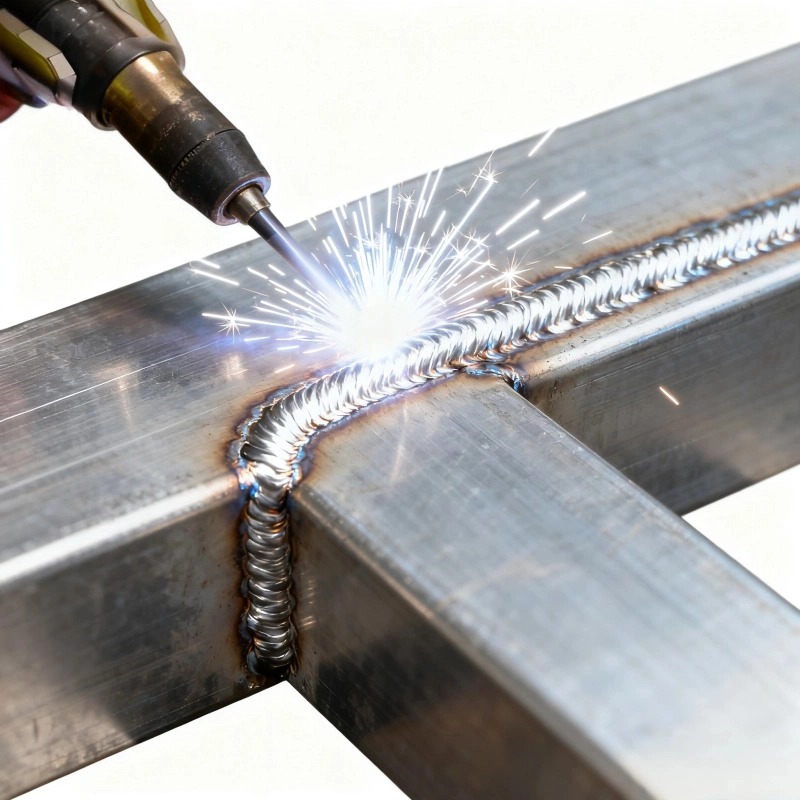
Strukturelles Aluminiumschweißen – Durchschweißverbindungen
Strukturelles Aluminiumschweißen: Durchschweißverbindungen, Rückwand, Vorwärmung auf 80-120 °C begrenzt, Nahtwirkungsgrad 50-65 % bei 6xxx, 85-95 % bei 5083.
Produktdetails
A welded frame and a welded structural member look similar on a drawing and are completely different to build. The frame carries load through its members; the structural member carries load through its joints. That single difference decides whether the weld has to be full penetration, whether it has to be inspected, and whether the alloy you chose is adequate.
We weld aluminium structural components in 6061-T6, 6063-T5, 5052 and 5083, from 1 to 40 mm, with MIG and TIG, to documented weld procedures, and with full-penetration joints and inspection where the load path requires it.
Partial penetration or full penetration
A fillet weld joins two surfaces at their corner. It is economical, it distorts less, and it is adequate when the load is carried by the members rather than through the joint. A full-penetration butt weld joins the full thickness of both parts. It is more expensive, it distorts more, and it is required when the joint has to carry the section's full load.
| Joint type | What it carries | Preparation | Prüfung |
|---|---|---|---|
| Fillet | Load at the corner, not through the thickness | Clean, no groove | Visual, size check |
| Partial penetration butt | Part of the thickness | Single-V or square groove | Visual, sometimes penetrant |
| Full penetration butt | The full section | V, U or K groove; backing or double-sided | Penetrant, radiographic or ultrasonic per specification |
Whether you need full penetration is a design question, not a workshop preference. If the joint is in a tension member, at a change of section, or in a fatigue-loaded part, it usually does. If it is at the end of a strut that carries compression, a fillet is usually enough. The drawing should say which, because the price difference is substantial.
Groove preparation on aluminium
Aluminium grooves are cut differently from steel grooves for two reasons. The metal conducts heat away about four times faster, so the groove has to concentrate the heat; and the oxide layer has to be removed from the groove faces, not just the surface.
V-groove for thickness up to about 12 mm: a 60–70° included angle, machined or routed, with the oxide removed from both faces.
U-groove for thicker sections: less filler metal than a V of the same depth, and better access for the arc at the root.
K-groove for a double-sided weld on thick plate: half the groove from each side, which balances the shrinkage and reduces distortion.
Backing. A full-penetration weld needs something at the root: a removable backing bar, a ceramic backing tape, or a weld from the second side. Without it, the root pass either falls through or does not fuse, and the joint is partial penetration that looks like full.
That last failure is the one worth watching for. A root that is not fused is invisible from outside and can pass a visual inspection. It is found by penetrant, by radiography, or by bending a test coupon — not by looking at the cap.
Preheat: necessary, and easy to overdo
Aluminium thick-section welding benefits from preheat, and the useful range is narrow.
Below about 80 °C on a thick section, the heat is conducted away faster than the arc can supply it, and the result is lack of fusion at the root. The weld looks fine on the cap.
Between 80 and 120 °C is the working range for thick sections: enough to establish the pool and achieve penetration, not enough to affect the temper significantly.
Above about 150 °C, and the alloy is being aged a second time. A 6061-T6 part held at 150–200 °C loses yield strength, permanently, in the region that reached that temperature — which is the heat-affected zone of the weld plus whatever the preheat reached.
So preheat has to be measured, not estimated with a hand on the plate. A contact thermometer or an infrared gun on the actual joint area, recorded, is the difference between a sound weld and a weakened part. This is one of the few places where an extra 30 °C costs strength rather than time.
The strength you get, honestly
Full penetration does not mean full strength. On a heat-treatable alloy, the heat-affected zone is the limit:
| Alloy and joint | Approximate joint efficiency | What to do about it |
|---|---|---|
| 6061-T6, full penetration, as welded | 50–65% of parent | Thicken locally, or design to the reduced allowable |
| 6061-T6, full penetration, post-weld aged | 80–90% | Accept the distortion and plan a straightening step |
| 5083-H116, full penetration | 85–95% | Usually adequate as designed |
| 5356 filler in 6xxx | Weld metal ~85–95%; HAZ is the limit | Filler choice does not fix the HAZ |
The third row is why 5083 is so common in welded structures that carry load: no precipitate to dissolve, so the joint efficiency is high and the design does not have to be thickened around every weld. If your structural member is a 6061-T6 extrusion, the joint efficiency has to be in the calculation, and the usual result is a local doubler or a thicker section at the connection.
Procedure and qualification
A structural weld is not a matter of the welder's judgement. It is performed to a documented weld procedure — the current, the voltage, the travel speed, the groove preparation, the filler and the preheat — and that procedure is qualified by testing a coupon: a tensile test, a bend test and, where specified, a macro-section.
What we can supply for a structural job: the weld procedure, the filler certificates, the material certificates with heat numbers, and the inspection records. What is usually a separate arrangement: third-party witnessed qualification, and acceptance to a specific structural code. If your project needs that, say so at enquiry — it changes both the schedule and the price, and it is much cheaper to plan than to discover.
Spezifikationen
| Element | Referenzwert |
|---|---|
| Anwendungen | Load-bearing frames, machine structures, brackets, supports, guards |
| Legierungen | 6061-T6, 6063-T5, 5052, 5083 |
| Prozesse | MIG, TIG, gas-shielded welding |
| Dickenbereich | 1–40 mm |
| Joint types | Fillet, partial penetration, full penetration |
| Groove types | V, U, K, square; with backing or double-sided |
| Preheat range for thick sections | 80–120 °C, measured and recorded |
| Festigkeit des Schweißguts | ≥85% of base metal |
| Nahtwirkungsgrad in der WEZ | Reference 50–65% for 6xxx; 85–95% for 5083 |
| Prüfung | Visual, dimensional, dye penetrant; radiographic or ultrasonic on request |
| Nachgelagert | CNC machining, stress relief where specified, surface treatment |
| Standard | ISO-9001-Qualitätsmanagementsystem |
Wo es nicht passt
- The joint has to carry full parent strength in 6061-T6 and cannot be thickened. Welding cannot deliver it as welded. Change to 5083, or design for post-weld aging with its distortion.
- You need a specific structural code qualification and third-party witness. That is a separate arrangement. Tell us at enquiry rather than at delivery.
- The part has to be both welded and anodised with no visible band. The HAZ anodises differently from the parent metal. Paint it, or put the weld where it is not seen.
- The tolerance on the finished part is tight. Welding distorts. Weld with stock and machine afterwards — there is no welding sequence that holds a machining tolerance on its own.
- The section is thin and the joint is full penetration. Burn-through and distortion both become likely. A fillet, or a thicker section at the joint, is the practical answer.
- The part is a fatigue-critical member. A welded aluminium joint is a fatigue detail regardless of penetration. If the design has high cycle counts, the joint needs to be out of the load path or the design needs a different connection.
Was für ein Angebot zu senden ist
Send the assembly drawing with the weld symbols — penetration and inspection class included — the alloys and thicknesses, the load case for each structural joint, the quantity, and the surface finish. Tell us if the part needs a documented weld procedure, and whether any inspection beyond visual is required.
We will reply with the joint preparation, the process and parameters, the preheat, the joint efficiency you should design to, the inspection we would perform, and the tolerance we can confirm after welding and after machining. Where a joint cannot deliver the strength the drawing assumes, that goes in the reply rather than in a test report.
FAQ
What weld quality and tolerance can you deliver?
Reference ≥85% of base metal in the weld metal, with a joint efficiency of 50–65% in the heat-affected zone for 6xxx alloys and 85–95% for 5083. On dimensions, reference ±0.5 mm as welded and ±0.05 mm on faces machined afterwards. Those are capability references: the value on your order is set by your drawing, and we confirm the joint efficiency and the dimensional acceptance you should design to in writing before you order.
How is structural welding different from frame welding?
The load path. In a frame, the members carry the load and the welds hold the geometry. In a structural member, the joint carries the load, which means full penetration, groove preparation, backing or a second side, and inspection. It also means the joint efficiency enters the design calculation rather than being assumed.
Do I need full penetration?
If the joint is in a tension member, at a change of section, or in a fatigue-loaded part, usually yes. If it is at the end of a compression strut, a fillet is usually enough. The drawing should state which, because the price and the inspection requirements differ substantially.
Why is preheat needed, and why is it limited?
Because aluminium conducts heat away about four times faster than steel, so a thick section needs preheat to achieve root fusion. But above about 150 °C the alloy starts to overage, so a 6061-T6 part loses strength permanently in the preheated zone. The working range is roughly 80–120 °C, measured on the joint, not estimated.
Is a full-penetration weld as strong as the parent metal?
In the weld metal, close. In the heat-affected zone, no — 50–65% of parent for 6061-T6 as welded. That is why structural aluminium parts are either thickened at the joints, post-weld aged, or made from 5083, whose joint efficiency is 85–95%.
What inspection can you provide?
Visual and dimensional as standard, dye penetrant on request, and radiographic or ultrasonic testing where specified. For a structural job we can supply the weld procedure record, filler certificates and material certificates with heat numbers. Third-party witnessed qualification is a separate arrangement — tell us at enquiry.
Wie wird es kalkuliert?
On the joint preparation, the weld volume, the preheat, the inspection and the machining. Full penetration with a groove and a backing is several times the work of a fillet of the same length, and a radiographic inspection adds a step. All of it is quoted explicitly rather than averaged into a rate.
Senden Sie Ihre Zeichnung
Email the assembly drawing with the weld symbols, the alloys, the load case and the inspection requirement to linjunbing@truetrustlv.com, or send it on WhatsApp at +86 136 6644 0600. You will get a joint preparation, a joint efficiency statement and a written tolerance range.
ANGEBOT ERHALTEN
Sobald Sie Ihre Anforderungen übermittelt haben, kontaktieren wir Sie so schnell wie möglich bezüglich Ihrer Produktanfrage.:Strukturelles Aluminiumschweißen – Durchschweißverbindungen