
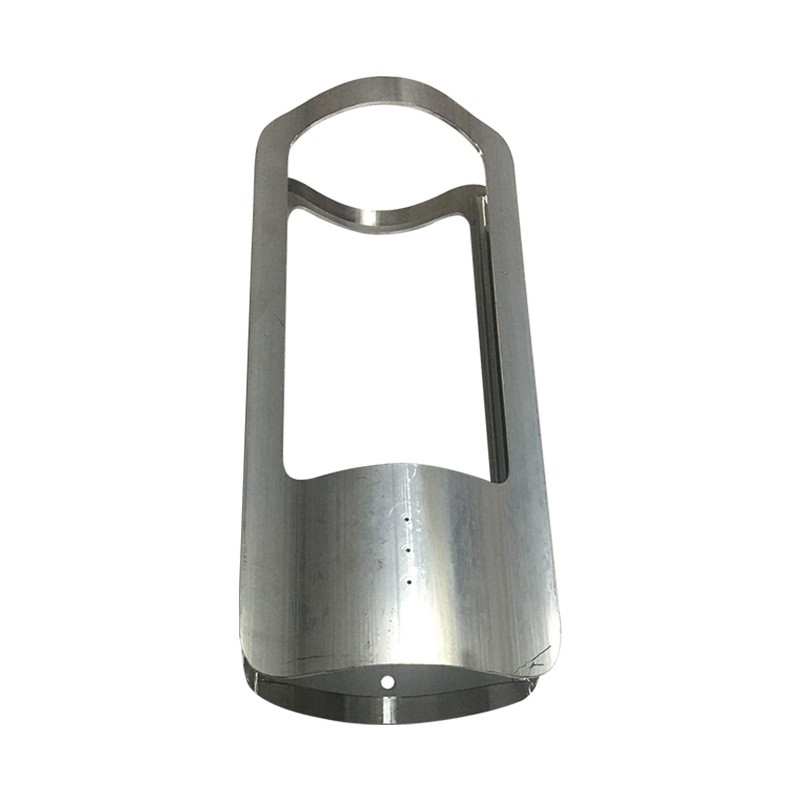
Aluminum Product Processing
Kavitätenbearbeitung in Aluminium – Taschen und Wandkontrolle
Tiefe Kavitätbearbeitung in Aluminium: Auskragungssteifigkeit fällt mit dem Kubus, minimaler Eckradius ≈ Tiefe/10, Späneabfuhr, Wandstärke ±0,03 mm.
Produktdetails
A deep cavity on a drawing looks like a pocketing operation. In the machine it is a tooling problem, and the tooling problem is arithmetic: a cutter's stiffness falls with the cube of its overhang. Doubling the stick-out does not halve the rigidity, it divides it by roughly eight.
We machine pockets and cavities in aluminium profiles and plate up to 500 mm high and 550 mm wide, to ±0.01–0.05 mm, with wall thickness control to ±0.03 mm, on three-axis and five-axis centres.
The overhang arithmetic
Deflection at the tool tip is proportional to the length of the overhang cubed, divided by the tool's moment of inertia. For a given cutter, that means:
| Overhang / diameter | Relative stiffness | Praktische Konsequenz |
|---|---|---|
| 2 : 1 | Reference, stiff | Normal feeds and speeds, good surface |
| 4 : 1 | About 1/8 of the reference | Reduced depth of cut; chatter possible at aggressive settings |
| 6 : 1 | About 1/27 | Light cuts only; taper and chatter become visible |
| 8 : 1 | About 1/64 | Chatter, tool breakage, poor wall finish; a different strategy is needed |
So a 100 mm deep cavity cannot be machined with a 10 mm cutter at any reasonable rate. Either the cutter gets bigger, or the cavity gets shallower, or the operation changes.
The alternatives when a cavity is genuinely deep:
- A larger cutter with a smaller reach per pass. A 20 mm cutter at 100 mm overhang is at 5:1, which is workable. The corner radius it leaves is 10 mm — which is the constraint on the design (see below).
- Tapered or relieved tooling. A cutter with a reduced shank above the flutes keeps the cutting diameter while increasing stiffness behind it. It costs more and it is the standard answer for a deep cavity with a small corner radius.
- Step down in stages with a finishing pass. Rough to depth at a lower overhang, then reach the bottom with a longer tool taking only a light finishing cut. The heavy cutting happens where the tool is stiff.
- Five-axis access. Tilting the tool lets it reach the bottom of a cavity at a shorter effective overhang against the wall. This is often the only way to hold both the corner radius and the wall finish.
The corner radius constraint is a design constraint
This is the point worth passing to your designer. A vertical internal corner in a milled pocket is a cylinder of the cutter's radius. The smallest corner radius a pocket can have is the radius of the smallest cutter that can reach the bottom of that pocket.
Take a pocket 80 mm deep. A cutter at a workable 5:1 overhang needs a 16 mm diameter, so it leaves an 8 mm corner radius. If the drawing specifies R2, the part cannot be made as drawn — not by us, and not by anyone. The choices are:
- Increase the corner radius to what the depth allows. R8 in this example. This is almost always acceptable for a pocket that holds a component, because the component has its own corner radius or clearance.
- Reduce the depth so a smaller cutter can reach. At 30 mm deep, a 6 mm cutter is at 5:1 and leaves R3.
- Machine the corner by another process — EDM, or a relieved cutter that can reach deeper. Both add cost.
The rule of thumb: minimum corner radius ≈ pocket depth / 10, for a cutter working at a comfortable 5:1 overhang. A pocket 60 mm deep wants R6 minimum; 100 mm deep wants R10. Designing to that rule avoids a redesign after the quotation.
Chip evacuation: the failure that ruins the finish
Aluminium cuts easily and its chips are soft and light. In an open pocket that is fine. In a deep cavity the chips have nowhere to go, and they get recut. Recutting produces three problems:
Built-up edge. Soft aluminium welds onto the cutting edge, changing the effective geometry and producing a torn, smeared surface.
Chip packing. Chips compact in the corner and the cutter has to cut through them, which spikes the load and breaks small tools.
Heat. Recut chips carry heat back into the cut, and aluminium does not show heat by colour, so the tool can be running hot without any visible sign.
The controls are straightforward and they are about the process, not the tool:
- Through-spindle or high-pressure coolant directed at the cut, which both cools and flushes.
- Air blast for pockets where coolant would be a problem downstream — it clears chips effectively in aluminium.
- Helikaler oder rampenförmiger Eintritt rather than plunging, so the cutter is never cutting on its centre.
- Adaptive or trochoidal paths that keep the radial engagement low and the chip load constant, which keeps the chip volume manageable and the load steady.
- Depth of cut over width of cut — in aluminium, a deep axial cut with a light radial step moves more metal with less heat and better chip evacuation than the reverse.
Wandstärkenkontrolle
A cavity leaves walls, and a wall deflects under cutting force. The reference of ±0.03 mm on wall thickness is achievable, and it depends on the wall being supported or being thick enough to resist.
Three things decide it:
The wall is supported by the remaining material. Machining the cavity from one side while the wall is still attached to a thick body keeps it stiff. Cutting it free early makes it flexible.
The cutting force is radial. It is the force pushing the wall away, and it is controlled by the radial engagement. A light radial step with a sharp cutter produces a small force and a correspondingly small deflection.
The part is machined symmetrically where possible. A wall machined from one side only ends up with a stress gradient across it, and it will bow.
Spezifikationen
| Element | Referenzwert |
|---|---|
| Maximum cavity height | 500 mm |
| Maximale Breite | 550 mm |
| Maximale Länge | 6,500 mm |
| Bearbeitungsgenauigkeit | ±0.01 to ±0.05 mm |
| Wandstärkenkontrolle | Reference ±0.03 mm |
| Oberflächenrauheit | Ra ≤ 1.6 µm standard; Ra ≤ 0.8 µm on request |
| Minimum corner radius | Approximately pocket depth / 10 |
| Legierungen | 6061-T6, 6063-T5, 6005-T6, 6082-T6, 7075-T5 |
| Coolant | Through-spindle, high pressure, or air blast |
| Oberflächenbehandlung | Eloxieren, Harteloxieren, Sandstrahlen, Bürsten, Pulverbeschichtung |
| Standard | GB/T 6892-2023 Hochpräzisionsgüte |
Wo es nicht passt
- The drawing specifies a sharp internal corner at depth. It cannot be milled. Increase the radius to depth/10, or accept an EDM operation with its cost and lead time.
- The cavity is deeper than five times its width and the walls are thin. Tool access and wall deflection both fail. A fabricated or a two-part construction is usually cheaper than machining it.
- The pocket floor is large and flat with a tight flatness requirement. A long-reach cutter leaves a dished floor. A larger cutter on a shorter overhang, or a finishing pass with a face mill where access allows, is needed.
- The part must be anodised and the cavity is deep. Anodising reaches into a cavity unevenly, and a deep narrow pocket may be coated thinly at the bottom. Check with the anodiser before designing it.
- The cavity is a pressure or vacuum chamber. Milled pockets are not pressure-tight in the wall thickness sense unless the wall is specified and tested. Say so at enquiry.
- The tolerance on wall thickness is tighter than ±0.02 mm on a thin wall. Cutting force deflection exceeds it. Either thicken the wall or accept a looser tolerance.
Was für ein Angebot zu senden ist
Send the part drawing with the pocket depths and the corner radii, the wall thicknesses, the tolerance on the wall, the alloy, the quantity and the surface finish inside the cavity. Tell us what goes into the cavity — a component with square corners needs a relief, and a fluid flow needs a radius, and those are different requirements.
We will reply with the tooling strategy, the corner radius the depth allows, whether a relieved cutter or five-axis access is needed, the wall thickness we can hold, and the machining time implication. If a corner radius is not machinable at the specified depth, that goes in the reply with the radius that would work.
FAQ
What accuracy can you hold in a cavity?
Reference ±0.01 to ±0.05 mm on dimensions and ±0.03 mm on wall thickness, with Ra ≤ 1.6 µm. Those are capability references: the value on your order is set by your drawing, and in a deep cavity the achievable tolerance depends on the tool overhang the depth forces. We confirm what is achievable at your depth in writing before you order.
What is the smallest corner radius you can machine?
It is set by the depth. A cutter working at a comfortable 5:1 overhang leaves a corner radius of roughly one tenth of the pocket depth: R6 for 60 mm deep, R10 for 100 mm deep. Smaller radii need a relieved or tapered cutter, or five-axis access, and both add cost.
Why does the surface finish deteriorate at the bottom of a deep pocket?
Chatter from tool overhang and chip recutting. Both get worse with depth: the tool is less stiff and the chips have further to travel. The fixes are a shorter effective overhang, high-pressure coolant or air blast to clear chips, and a lighter radial engagement.
How is wall thickness controlled?
By keeping the wall attached to stiff material for as long as possible, by using a light radial engagement so the cutting force is small, and by roughing and finishing separately so the wall can relax. Machining symmetrically where the geometry allows keeps the stress balanced.
Can a deep cavity be machined from a solid extrusion?
Yes, within the overhang limits. If the cavity is deeper than about five times its width, the tooling and the wall deflection both become the limit, and a fabricated or two-part construction is usually cheaper than machining it out of solid.
Does the cavity affect anodising?
Yes. Anodising reaches into a cavity less effectively than onto an open face, and a deep narrow pocket can end up with a thin coating at the bottom. For a cavity that has to be fully coated, discuss it with the anodiser at design stage rather than discovering it at finishing.
Wie wird es kalkuliert?
On the volume removed, the depth, the corner radii and the tolerance. A deep cavity is priced by the time the tool spends at a light cut, not by the metal removed — which is why two pockets of the same volume can differ by a factor of two.
Senden Sie Ihre Zeichnung
Email the part drawing with the pocket depth, the corner radii and the wall tolerances to linjunbing@truetrustlv.com, or send it on WhatsApp at +86 136 6644 0600. You will get a tooling strategy, the machinable corner radius and a written tolerance statement.
ANGEBOT ERHALTEN
Sobald Sie Ihre Anforderungen übermittelt haben, kontaktieren wir Sie so schnell wie möglich bezüglich Ihrer Produktanfrage.:Kavitätenbearbeitung in Aluminium – Taschen und Wandkontrolle