
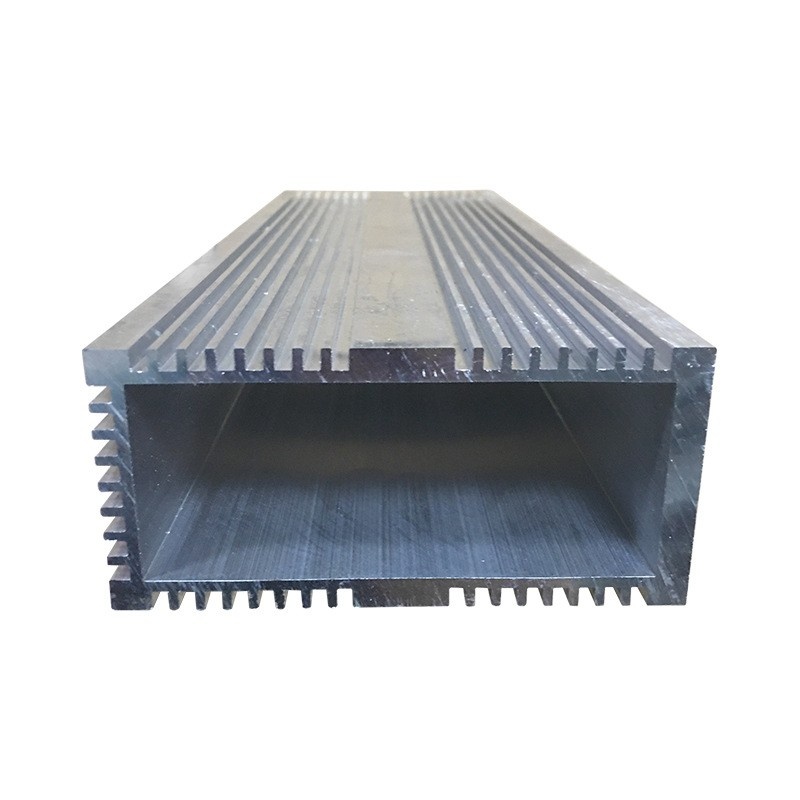
Aluminum profiles for radiators
Kühlkörper-Aluminiumprofil für Energiespeicheranlagen
Kühlkörperprofile für Energiespeicher in 6063-T5 bei 201 W/m-K, schwarz eloxiert auf 0,8 Emissionsvermögen, Ebenheit 0,05 mm pro 100 mm. Querschnitt und Veredelung nach Zeichnung.
Produktdetails
Kurze Antwort: an energy storage heat sink profile is an extruded 6063-T5 body that cools the PCS, the DC-DC stage or the cabinet power modules of a battery energy storage system. These units run 24/7 outdoors, so the design targets sustained thermal resistance and a surface that survives a decade of sun and dust, not a peak number on a bench. Working reference: 200–201 W/m·K on 6063-T5, black anodizing to lift emissivity from about 0.1 to 0.8. Section and tolerance per your drawing.
Wofür es verwendet wird
It goes into power conversion systems (PCS) for utility-scale and commercial battery storage, photovoltaic inverters, hybrid inverter cabinets, DC-DC converters inside battery racks, and the thermal path for cabinet-level power electronics in containerized storage.
The power range is wide, roughly 5 kW to 100 kW per unit. Low and medium power units usually run one or two sections with a compound profile. Higher power units move to multi-channel sections or a liquid loop, because air alone stops being enough once the heat flux at the module base climbs.
One thing worth stating plainly, because it is often mixed up in a brief: a battery storage system has two separate thermal problems. The cells are cooled by a liquid cold plate, because cell-to-cell temperature difference is a safety and aging issue. The PCS and the power electronics are usually air cooled through an extruded heat sink. This page is about the second one. If your enquiry is about the cold plate, say so and we will quote it as a different part.
Spezifikationen
| Element | Arbeitsreferenz | Wie es festgelegt wird |
|---|---|---|
| Legierung | 6063-T5 standard, 1070 for high conductivity, 6061-T6 for structural mounting | Chosen against your load and strength case |
| Wärmeleitfähigkeit | 200–201 W/m·K on 6063-T5, about 226 W/m·K on 1070 | Materialeigenschaft, durch Legierung festgelegt |
| Grundebenheit | ≤0.05 mm per 100 mm | Durch Ihre Zeichnung festgelegt |
| Rippenstärke | ±0.03 mm | Durch Ihre Zeichnung festgelegt |
| Rippenabstand | 10–15 mm outdoors, wider where dust load is high | Set by your maintenance interval and site |
| Oberfläche | Black anodized, or outdoor grade powder coat | Set by your emissivity and corrosion target |
| Corrosion performance | Salt spray and UV resistance to the level your drawing calls | Set by the site class |
| Bearbeitung | Milling, drilling, tapping, deburr | Nach Ihrer Schnittstellenzeichnung |
Wie es hergestellt wird
- The section is extruded in one piece, fins and base together, which removes the interface that assembled heat sinks carry.
- The base is milled to flatness and the mounting holes are machined on the same datum, so the module clamps down evenly.
- Anodizing or coating follows, with the type chosen for emissivity as well as corrosion rather than for appearance.
- Threads and grounding points are masked where the drawing requires bare metal contact.
- Inspection checks flatness and finish on the finished part, since a coating and a clamp can both move a thin base.
Wo dies passt
It fits when the cabinet has an external fin face, when the heat load is within what natural or forced convection can move, and when the section has to follow the enclosure rather than a catalogue list.
Wo es nicht passt: if the load needs a liquid loop, an air heat sink will not get there no matter how the fins are shaped. If the cabinet has to stay sealed to a high IP rating, the heat has to leave through a wall, and that is a different design conversation than a finned external face. And for a sealed indoor unit at low volume, a purchased catalogue heat sink is the cheaper route.
Why outdoor duty changes the design
The radiation share is not a detail. Bare aluminum has an emissivity near 0.1, and in that state radiation carries under 5 percent of the heat. Black anodizing takes emissivity to about 0.8 and the radiation share to roughly 23 percent. On an outdoor unit that runs continuously, that difference is worth real degrees at the module, and it costs a finishing step rather than a bigger extrusion. It is also the cheapest thermal gain available on this product, and it is routinely left out of the brief.
The fin gap is a maintenance dimension. A 4 mm pitch looks excellent on a datasheet and packs solid with dust and pollen in two seasons on a solar farm or an roadside cabinet. Once the channels block, the fin area is still there and none of it works. Outdoors we argue for a wider gap and fewer, thicker fins, and we would rather lose a little bench performance than have the unit derate in year three because nobody can clean it.
Steady state matters more than peak. A storage converter cycles hard but runs long. What the operator feels is not the worst ten minutes, it is the thermal resistance after years of dust, thermal cycling and clamp relaxation. That is an argument for a one-piece extrusion with a machined interface, a stable coating, and screws specified with a torque value, because a heat sink that loses clamp pressure loses performance silently.
Was für ein Angebot zu senden ist
- The enclosure drawing, with the external fin face and the mounting interface dimensioned
- Heat load in watts, ambient range, and whether the site is coastal, desert or rooftop
- Cooling method and whether the cabinet is sealed
- The IP rating and the cleaning interval expected in service
- Alloy and finish requirement, or the corrosion and emissivity target if those are open
FAQ
What tolerance can you hold on a storage heat sink?
Base flatness at or under 0.05 mm per 100 mm and fin thickness within ±0.03 mm are our reference values on this family. The value on your order is set by your drawing, and we confirm it in writing before quotation. If a number is not achievable in production we say so at that stage rather than at first article.
How much does black anodizing actually help?
On an untreated surface emissivity is about 0.1 and radiation removes under 5 percent of the heat. Black anodizing brings emissivity to roughly 0.8 and the radiation share to about 23 percent. It also protects against UV and salt fog, which matters more than the thermal gain over a ten-year life.
Can you match the heat sink to a sealed cabinet?
Yes, within limits. A sealed cabinet has to move heat through its wall, so the heat sink becomes a wall element and the interface between the internal source and that wall matters as much as the fins. Send the internal layout and we will say whether an external fin face alone is realistic.
What alloy for a coastal installation?
6063-T5 with anodizing is the normal choice, and the anodizing thickness and sealing matter more than the alloy for salt fog. Where the part is also structural, 6061-T6 is used. The site class drives the finish specification, and we would rather set it from the site than from a generic standard.
Do you make both the cold plate and the heat sink?
We make extruded and machined aluminum thermal parts, including liquid cold plates and air heat sinks. They are separate parts with separate specifications, so we quote them separately and state which drawing each one answers to.
Can the section be developed for a new cabinet?
Yes. A new section means a die, which is a real cost and a real lead item, so it only makes sense once the mechanical interface is fixed. If the design is still moving, we will suggest machining from a stock section first and tooling later.
Nächster Schritt
Send the enclosure drawing with the heat load, the ambient range and the site class. We will come back with a proposed section, an alloy and finish, and a tolerance statement against your drawing.
E-Mail: linjunbing@truetrustlv.com | Anrufen oder WhatsApp: +86 136 6644 0600
ANGEBOT ERHALTEN
Sobald Sie Ihre Anforderungen übermittelt haben, kontaktieren wir Sie so schnell wie möglich bezüglich Ihrer Produktanfrage.:Kühlkörper-Aluminiumprofil für Energiespeicheranlagen