
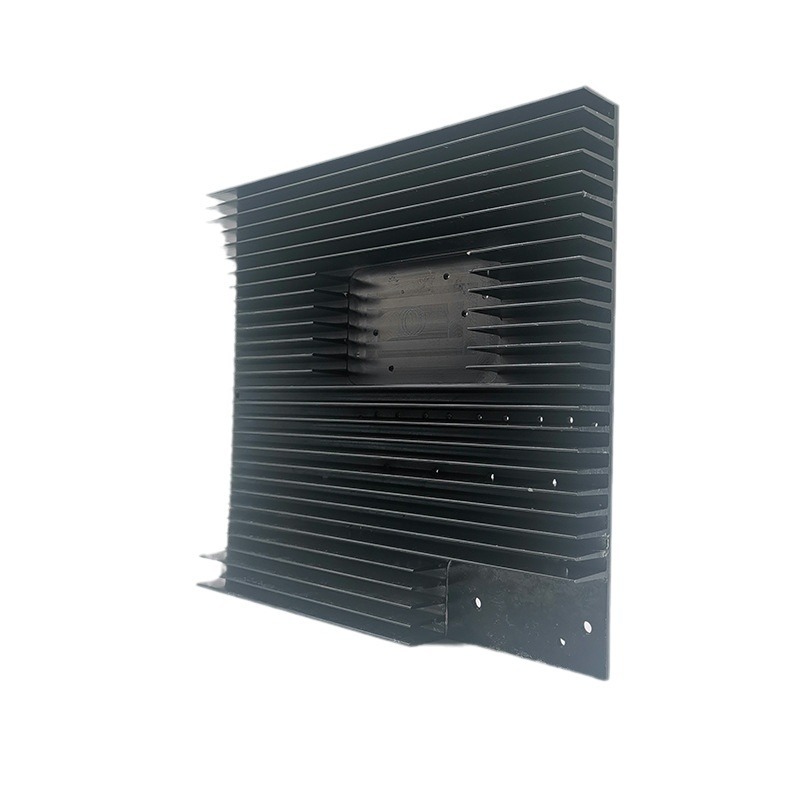
Aluminum profiles for radiators
Laser Heat Sink Aluminum Profiles
Laser heat sink profiles in 6063-T5 or 1070 at 226 W/m-K, base flatness 0.05 mm per 100 mm, Ra 1.6 on the mating face. Section and tolerance per drawing.
Produktdetails
Kurze Antwort: a laser heat sink profile is an extruded aluminum body that holds a diode bar, a fiber gain module or a laser housing at a stable temperature while carrying away hundreds of watts. The job is stability, not minimum temperature, because output power and emission wavelength both move with junction temperature. Working reference: 201 W/m·K on 6063-T5, 226 W/m·K on 1070, flatness at or under 0.05 mm per 100 mm. The section and the tolerance are set by your drawing.
Wofür es verwendet wird
It goes under high-power semiconductor lasers, fiber laser gain modules, pump diode stacks, laser marking and engraving heads, cutting and welding heads, and the diode arrays inside medical and scientific instruments.
These are not general electronics loads. A single high-power bar can put 100 W or more into a spot a few millimeters wide, and the heat flux at the interface is an order of magnitude above what a normal heat sink sees. A fiber laser cavity has to hold its temperature within a narrow band or the center wavelength walks off the specification, and in a cutting head that shows up as a change in focus and a change in cut quality through the shift.
Spezifikationen
| Element | Arbeitsreferenz | Wie es festgelegt wird |
|---|---|---|
| Legierung | 6063-T5 standard, 1070 for high conductivity | Chosen against your load and weight limits |
| Wärmeleitfähigkeit | 201 W/m·K on 6063-T5, 226 W/m·K on 1070 | Materialeigenschaft, durch Legierung festgelegt |
| Grundebenheit | ≤0.05 mm per 100 mm | Durch Ihre Zeichnung festgelegt |
| Surface roughness on the mating face | Ra 1.6 µm or better after milling | Durch Ihre Zeichnung festgelegt |
| Rippenstärke | ±0.03 mm | Durch Ihre Zeichnung festgelegt |
| Profiltyp | Dense fin, skived fin, star, or channel body for a liquid loop | Chosen against the load and the airflow |
| Surface finish | Anodized or chromate conversion | Set by your housing and corrosion requirement |
| Bearbeitung | Milling, drilling, tapping, precision cut, deburr | Nach Ihrer Schnittstellenzeichnung |
Wie es hergestellt wird
- The body is extruded in one piece, so the path from the mounting face to the fins has no joint and no bond line.
- The mounting face is milled flat and to roughness. On a laser interface this face does most of the thermal work, and a rough face is a thicker grease layer, which is thermal resistance you paid for.
- Holes, dowel positions and clamping features are machined on the same datum as the milled face so the bar or module seats without bending.
- Where the design calls for a liquid path, the channel is machined and the plate is closed by a method agreed at quotation, with leak testing before finish.
- Finish and final inspection follow, with flatness checked on the finished part rather than on the raw extrusion.
Wo dies passt
It fits when the laser or the diode assembly has a flat mounting face, when the load is in the range a solid aluminum body can spread, and when the mechanical interface is specific enough that a catalogue profile will not do.
Wo es nicht passt: above a certain power density a solid extrusion runs out of spreading ability and the right answer is a microchannel or a vapor chamber, not a thicker base. If the requirement is a coated, optically finished surface, that is a different supply chain. And for a one-off prototype the die cost usually outweighs the benefit, so we would point you at a machined block instead.
The three things that actually decide the result
Flatness is a thermal number, not a cosmetic one. At 0.05 mm per 100 mm the gap under the bar is small enough for the interface material to bridge it. Open that gap and the air in it conducts at roughly 0.026 W/m·K, which is close to nothing. On a high-flux interface a fraction of a millimeter of unfilled gap can cost more temperature than the entire extrusion's spreading resistance.
CTE mismatch is the failure mode nobody quotes. Aluminum expands at about 23 µm/m·K and the semiconductor at 4 to 6. Across a 10 mm laser bar that is a large shear every thermal cycle. Over thousands of cycles the solder or sinter layer fatigues and the bar walks out of alignment. The fix is a design decision, not a process claim: a compliant interface layer, a shorter rigid span, or a different base material at the interface. We raise it at quotation because it decides whether the part lasts.
Aluminum versus copper is a weight decision on a moving head. Copper conducts about twice as well, but it is more than three times denser. On a stationary rack copper usually wins on performance. On a cutting or welding head that accelerates, the added mass costs motion performance and can cost more than the thermal gain. That trade is worth doing explicitly rather than defaulting to copper.
Was für ein Angebot zu senden ist
- The drawing of the laser or module and the heat sink, with the mounting face dimensioned
- Heat load in watts, the allowed temperature rise, and the stability band the wavelength needs
- Cooling method: natural convection, forced air, or liquid
- Whether the head moves, because it decides the weight budget
- Interface material or the surface finish the assembly expects
FAQ
What flatness and tolerance can you hold?
Base flatness at or under 0.05 mm per 100 mm and fin thickness within ±0.03 mm are our normal reference values on this product family, measured on the finished part. The value on your order is set by your drawing, and where a tighter number is possible we confirm it in writing before quotation rather than after the first article.
Why is stability more important than a low absolute temperature?
Because the output depends on temperature, not on how cold the part is. Emission wavelength shifts as junction temperature moves, and output power degrades as the diode heats. A design that runs at a stable 45 °C is more useful than one that swings between 30 and 55 °C, even though its average is lower.
Do you make liquid-cooled laser cold plates?
Yes. For high-flux arrays the body is machined with a channel and closed, with the joint method and the leak test agreed at quotation. The sealing method is part of the design review, because on a laser head a leak is not a maintenance item, it is a scrap event.
6063 or 1070 for a laser heat sink?
6063-T5 for anything that carries structural or clamping load. 1070 where the spreader has to move heat fast and the part is supported elsewhere. The conductivity difference is roughly 12 percent, and the strength difference is much larger than that, so the choice is usually made by the mechanics rather than the thermal number.
Can you machine the optical or mounting features too?
We machine the mechanical features: faces, bores, slots, tapped holes and clamp seats. Optical surfaces and coatings sit outside our scope, and if your drawing includes them we will say so in the quotation instead of quietly excluding them later.
What about surface treatment near the interface?
Anodizing on a mating face adds a layer under the bar. Where the drawing calls for bare metal at the interface, we mask it, and the masking is agreed before production because it changes the process sequence.
Nächster Schritt
Send the module drawing and the heat load with the stability band you need. We will come back with a proposed section, an alloy, and a written tolerance statement against your drawing.
E-Mail: linjunbing@truetrustlv.com | Anrufen oder WhatsApp: +86 136 6644 0600
ANGEBOT ERHALTEN
Sobald Sie Ihre Anforderungen übermittelt haben, kontaktieren wir Sie so schnell wie möglich bezüglich Ihrer Produktanfrage.:Laser Heat Sink Aluminum Profiles