
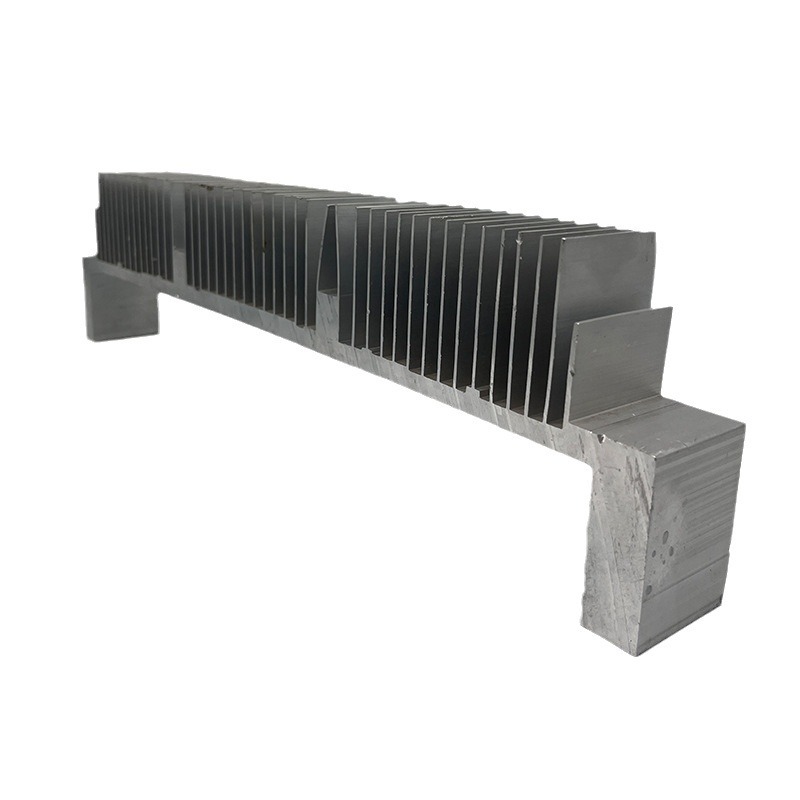
Aluminum profiles for radiators
Kühlkörper-Aluminiumprofil für 5G-Kommunikation
5G-AAU- und RRU-Kühlkörperprofile in 6063-T5 bei 201 W/m-K, Rippenstärke +/-0,03 mm, Bogenebenheit 0,05 mm pro 100 mm. Querschnitt und Veredelung nach Zeichnung.
Produktdetails
Kurze Antwort: a 5G heat sink profile is an extruded 6063-T5 section that carries the AAU or RRU heat load by natural convection, usually with no fan. The numbers that matter are fin thickness held to ±0.03 mm, base flatness at or under 0.05 mm per 100 mm, and a fin gap wide enough that the boundary layers do not merge. Working reference: 201 W/m·K on 6063-T5, 226 W/m·K on 1070. The section, the alloy and the finish are set by your drawing and your enclosure, not by this page.
Wofür es verwendet wird
A 5G base station draws far more power than the 4G equipment it replaces. An AAU that integrates the antenna array and the RF front end together runs at 2.5 to 4 times the power of a 4G RRU, and peak draw on a single AAU can pass 1000 W. That heat has to leave through a surface that is bolted to a pole, high up, with no maintenance access.
The same profile family goes into RRUs, remote radio heads, outdoor communication cabinets, microwave backhaul units and edge compute boxes mounted at the mast. A typical AAU carries 0.3 to 0.6 m² of heat sink surface and 1.5 to 3 kg of aluminum, which tells you the design is weight-limited before it is area-limited.
This matters because 5G sites are specified to run from -40 °C to 55 °C ambient, in sun, rain, salt fog and wind. The heat sink is a structural part of the radio, not an accessory bolted on afterwards.
Spezifikationen
| Element | Arbeitsreferenz | Wie es festgelegt wird |
|---|---|---|
| Legierung | 6063-T5 standard, 1060 or 1070 for high conductivity | Chosen against your load case and strength requirement |
| Wärmeleitfähigkeit | 201 W/m·K on 6063-T5, 226 W/m·K on 1070 | Materialeigenschaft, durch Legierung festgelegt |
| Rippenstärke | ±0.03 mm | Durch Ihre Zeichnung festgelegt |
| Grundebenheit | ≤0.05 mm per 100 mm | Set by your drawing, measured on the mating face |
| Rippenabstand | 8–12 mm for natural convection | Set by your mounting orientation and load |
| Oberfläche | Anodized, clear or black, 10–20 µm | Set by your corrosion and emissivity requirement |
| Profile length | Cut to your dimension, typically 300–1200 mm | Set by your enclosure |
| Bearbeitung | Drilling, tapping, milling, deburring | Nach Ihrer Schnittstellenzeichnung |
Wie es hergestellt wird
- Billet is heated and pressed through a die that forms the fins and the base in one piece, so there is no thermal joint anywhere in the heat path.
- The extruded length is cut, then aged to T5 so the conductivity and the strength are both stable before machining.
- The mating face is milled flat. This is the step that decides contact resistance, and it is why a cheap extrusion with a good section can still fail thermally.
- Mounting holes, cable entries and grounding points are drilled and tapped on the same datum as the milled face, so the radio seats without stress.
- Anodizing follows, then a flatness check on the finished part, because anodizing and handling can both move a thin base.
Wo dies passt
It fits when the radio is passively cooled or lightly fan-assisted, when the enclosure already has a defined footprint, and when the project needs a section that is specific to the mechanical interface rather than a catalogue profile cut to length.
Wo es nicht passt: if the heat load needs a vapor chamber or a liquid loop, an extrusion is the wrong answer and we will say so. If the design is still moving week to week, a die is money spent too early. And if the requirement is a stock profile in small quantity, a catalogue supplier will beat us on both price and speed.
The constraint that decides the design
Most 5G heat sink briefs start with surface area, and that is the wrong place to start. The real limits are weight on the pole, wind load on the mounted surface, and the fin gap the airflow can actually feed.
Once a fin gap falls below about 8 mm in natural convection, the boundary layers on the two facing walls merge and the channel stops moving air. Adding fins past that point adds weight, adds wind area, and adds almost no cooling. This is why a dense 4 mm fin pitch that works well in a forced-air cabinet performs worse than a 10 mm pitch outdoors with no fan.
The second limit is conductivity versus strength. Moving from 6063 to 1070 buys roughly 12 percent more conductivity, but 1070 is soft. On a pole-mounted AAU the heat sink carries the radio's mounting loads, so the usual answer is 6063-T5 for the structure with 1070 only where a local spreader needs it. Selling a full 1070 body to a customer who has not checked the mechanical case is how a thermal win turns into a field failure.
The third is finish. Bare aluminum has an emissivity near 0.1. Anodizing, particularly black anodizing, lifts that toward 0.8, which changes the radiation share from a few percent to a real contribution. On an outdoor passively cooled part, that is not cosmetic. It is part of the thermal budget.
Was für ein Angebot zu senden ist
- The section drawing, or the enclosure drawing with the mounting interface dimensioned
- Heat load in watts, ambient range, and whether the unit is passive or fan-assisted
- Mounting orientation, because it decides which fin direction is viable
- Alloy and finish requirement, or the corrosion and emissivity target if the alloy is open
- Quantity per year and the tolerance that actually matters to your assembly
FAQ
What thermal conductivity can you hold?
6063-T5 runs about 201 W/m·K and the 1070 series about 226 W/m·K. Those are material values, not process claims. The value on your order is set by your drawing and the alloy you specify, and we confirm it in writing before quotation. If the load case needs more than the alloy gives, the answer is a different section, not a higher number on paper.
Why does the heat sink need anodizing outdoors?
Three reasons. Corrosion and salt fog attack bare aluminum, UV degrades any organic coating that is not formulated for it, and anodizing raises emissivity so the part radiates instead of relying only on convection. It also hardens the surface against handling damage during installation.
Can you make a fin gap thinner than 8 mm?
Yes, and extrusion will hold it. Whether it helps depends on the airflow. In natural convection a tight gap usually costs performance, so we would rather discuss the mounting orientation and the load than simply quote the densest section you can draw.
Do you machine the mounting interface?
Yes. Flatness and hole position are machined on one datum after extrusion, because an as-extruded base will not hold 0.05 mm per 100 mm reliably and the interface is where contact resistance is won or lost.
What decides whether the extrusion or a die-cast housing is right?
Volume and section complexity. An extrusion gives a continuous, joint-free heat path and a low tooling cost, which suits long constant sections. A die casting wins when the housing has to be a closed three-dimensional shape. Below a certain annual volume the extrusion is almost always the cheaper and thermally better route; above a certain complexity it is not.
Can you supply the heat sink with the housing as one assembly?
We extrude, machine, finish and assemble the aluminum parts. If the assembly includes inserts, gaskets or hardware, send the bill of materials and we will quote the aluminum scope and state clearly what sits outside it.
Nächster Schritt
Send the section drawing or the enclosure drawing with the heat load and the ambient range. We will come back with a feasibility view, a proposed alloy and a tolerance statement against your drawing.
E-Mail: linjunbing@truetrustlv.com | Anrufen oder WhatsApp: +86 136 6644 0600
ANGEBOT ERHALTEN
Sobald Sie Ihre Anforderungen übermittelt haben, kontaktieren wir Sie so schnell wie möglich bezüglich Ihrer Produktanfrage.:Kühlkörper-Aluminiumprofil für 5G-Kommunikation