
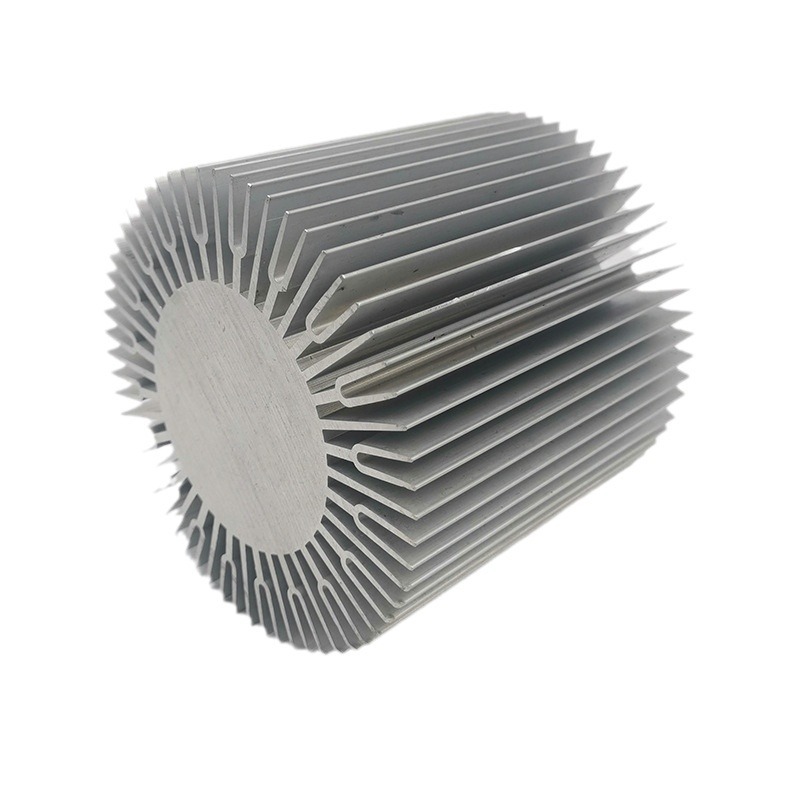
Aluminum profiles for radiators
LED Lighting Heat Sink Aluminum Profile
LED heat sink profiles in sunflower, comb and high-density fin sections at 201 W/m-K, flatness 0.05 mm per 100 mm. Section and finish agreed per drawing.
Produktdetails
Kurze Antwort: an LED heat sink is an extruded aluminum profile that carries the LED board, spreads its heat into the fins and often forms part of the luminaire structure. The fin geometries — sunflower, high-density fin, comb and mountain section — are formed by the die in one piece, at 6063-T5 and about 201 W/m·K, with fin thickness held to ± 0.03 mm and base flatness to ≤ 0.05 mm/100 mm. Because LED life is set by junction temperature, the sink is not an accessory to the light, it is what determines how long the light lasts. Section and finish are confirmed against your drawing.
Junction temperature is the life specification
An LED does not usually fail by burning out. It fails by dimming, slowly, over years, and the rate at which it dims is governed almost entirely by the temperature of the semiconductor junction inside the package. The relationship is steep: within the normal operating range, every 10 °C rise at the junction roughly halves the useful life. A luminaire designed for 50,000 hours at a junction of 85 °C will not deliver 50,000 hours if the same design runs at 105 °C in a warmer ceiling.
The second effect is efficiency. An LED's light output drops as it heats, so a poorly cooled fixture consumes the same power and emits less light. That is a direct commercial loss for the fixture maker: the product is sold on lumens per watt, and the figure on the datasheet is measured at a junction temperature the finished luminaire may never reach. A heat sink that is undersized by a small margin costs more in lost output than it saves in aluminum.
This is why the heat sink design starts from the thermal path, not from the section catalogue. Heat has to travel from the junction, through the package and the solder joint, through the board, through the interface material, into the base of the profile, along the fins and finally into the air. Each step has a resistance, and the sink only controls the last two. A sink that is excellent but mounted on a board with a poor interface, or in a housing with no airflow, will still run the junction hot.
Spezifikationen
| Element | Bereich |
|---|---|
| Construction | One-piece extrusion; fin array and functional features formed by the die |
| Legierung | 6063-T5, thermal conductivity about 201 W/m·K |
| Fin structures | Sunflower, high-density fin, comb, mountain section, or as drawn |
| Fin thickness tolerance | Reference ±0.03 mm |
| Grundebenheit | Reference ≤ 0.05 mm per 100 mm |
| Integrierte Merkmale | Card slots, lens guide rails, diffuse-reflection cavities, modular splice joints |
| Ingress protection | Up to IP65 in suitable designs |
| Oberflächenbehandlung | Anodizing (natural or black), brushing, sandblasting |
| Referenznorm | GB/T 6892-2023, high-precision grade |
| Deep processing | CNC base milling, drilling and tapping, precision cut to length, deburring |
Orientation: the constraint extrusion has and sunflower does not
This is the design decision most often missed, because a heat sink is usually specified on a bench where orientation does not matter and then installed in a luminaire where it does.
A flat linear fin array has a preferred axis. With the fins vertical, air rises freely between them and the chimney effect pulls cool air in from below; the sink performs close to its rated figure. With the same sink installed horizontally, the fins become horizontal plates, air has to travel sideways to escape, and the boundary layers on adjacent fins thicken until the array is effectively one solid block of warm air. The thermal resistance can roughly double, which is the difference between a junction at 80 °C and one at 130 °C.
A sunflower section, where fins radiate in all directions from a central core, has no preferred axis. It performs similarly whichever way the luminaire is mounted, which is why it dominates in downlights, high-bay fittings and track heads where the installation angle is not controlled by the designer. The cost is that it is generally less efficient than a well-oriented linear array of the same mass, because not all of its fins are in the optimal orientation at once.
So the rule is: if the luminaire's mounting orientation is fixed and known, a linear fin array can be tuned to it and will outperform a sunflower for the same aluminum. If the orientation is variable, or the fixture is aimed, sunflower is the safer choice and the number on the drawing should be the worst orientation, not the best.
Finishing: appearance, corrosion, and a small thermal effect
Surface treatment on an LED profile does three things, and only two of them are usually considered.
- Corrosion and handling. Anodizing protects the aluminum in outdoor and humid service, and gives a surface that does not mark when handled. On a street light this is the primary reason for specifying it.
- Appearance. Natural, black, brushed and sandblasted finishes let the sink read as part of the fixture design rather than as a raw extrusion. On architectural and consumer fixtures this is the deciding factor.
- Radiation. A black anodized surface has a higher emissivity than bare aluminum, which improves heat rejection by radiation. In natural convection, where radiation can account for a meaningful share of the total, this genuinely helps. In forced convection over a metal housing, the effect is small next to the convection term.
There is a small cost: the anodized layer is an oxide with lower thermal conductivity than the metal below it. At the thicknesses used, this is negligible relative to the other resistances in the stack, and it does not change a design decision. It is worth knowing only because it explains why a heavily coated sink can measure marginally worse than the same sink bare.
Integrating the optics and the seal
An LED profile often does more than dissipate heat. A single extrusion can carry card slots for the LED board, guide rails for a lens or diffuser, and a diffuse-reflection cavity that shapes the light output. Forming these features in the same die as the fins removes assembly steps and, more importantly, removes tolerance stack-up: the LED board, the lens and the heat sink are located by the same piece of metal rather than by three separate parts bolted together.
The tension is with ingress protection. A sealed luminaire traps heat, so the better the IP rating, the harder the thermal job. IP65 means a gasket and a closed cavity, which stops the convective exchange that an open fixture would have. The most effective designs handle this structurally: the heat sink stays outside the sealed optical chamber, so the LED board is protected while the fins still see ambient air, and the seal is placed at the boundary between the two rather than around the whole fixture.
Wo dies passt
- High-power street lights and high-bay fittings, where junction temperature drives the warranty
- Flood lights and sports lighting, where the fixture is aimed and the orientation changes
- Track and architectural lighting, where the profile is also the visible body of the fixture
- Linear luminaires where the extrusion carries the board, the lens and the sink as one part
- Outdoor and humid service, where anodized protection and a sealed optical chamber are both needed
Wo es nicht passt
- Very high power density in a small envelope, where the fin aspect ratio cannot be extruded and a bonded or skived sink is required.
- Low-volume custom fixtures, where the die cost exceeds the value of the parts.
- Designs that need complex three-dimensional fin geometry or an embedded heat pipe.
- Cases where the fixture is sealed on all sides with no thermal path to ambient, where no sink shape will fix the problem.
Was für ein Angebot zu senden ist
- The LED board footprint, the power it dissipates and the junction temperature target
- The mounting orientation of the finished luminaire, since it changes the section choice
- The ambient and the enclosure conditions: open air, sealed housing, or inside a ceiling void
- Which functional features the profile has to carry: board slots, lens rails, reflection cavity, seal groove
- The required IP rating and where the seal boundary runs
- The surface finish, and whether it is for appearance or for radiation
- Quantity and the required length
If the thermal design is still open, send the LED datasheet and the fixture concept. A section and fin geometry can be proposed from the dissipation and the orientation, and the estimate of junction temperature comes with it.
FAQ
What flatness and fin tolerance can you hold?
As a reference, base flatness ≤ 0.05 mm per 100 mm and fin thickness deviation ± 0.03 mm. Both depend on the fin density and the section width, and both are confirmed against your drawing before production, and the value on your order is set by your drawing. On a high-density array the fin tolerance is the harder of the two to hold, and it matters because uneven gaps disturb the airflow between fins.
How much does mounting orientation change the performance?
On a linear fin array, substantially: fins vertical is the good case, fins horizontal can roughly halve the effective performance because the air can no longer rise freely between them. On a sunflower section the difference is much smaller because there is no preferred axis. If the installation orientation is not fixed, specify the sunflower and size it for the worst case.
Does anodizing reduce heat dissipation?
The oxide layer has lower conductivity than the metal, but at normal thickness the effect is negligible against the other resistances in the path. Against that, a black anodized surface radiates better, which helps in natural convection. The net effect is usually neutral to slightly positive, and anodizing should be chosen on corrosion and appearance grounds rather than on thermal ones.
Can the profile carry the lens and the board as well as the fins?
Yes, and it is one of the main reasons to use an extrusion rather than an assembly. Board slots, lens guide rails and reflection cavities can be formed in the same die, which locates all three from one piece of metal and removes the tolerance stack-up of bolting separate parts together. Send the optical and mechanical requirements with the thermal ones so they are designed into the section rather than added later.
What does IP65 cost in thermal terms?
A sealed luminaire traps heat, so the same sink will run a higher junction temperature once the optical chamber is closed. The usual solution is structural rather than thermal: keep the heat sink outside the sealed chamber so the fins still see ambient air, and put the gasket at the boundary. If the whole fixture has to be sealed, the sink has to be sized for the sealed case, which is a different and larger section.
What finishes are available?
Natural anodizing, black anodizing, brushing and sandblasting, chosen for appearance, corrosion resistance or radiation as the application requires. A brushed or sandblasted texture is usually applied before anodizing so the texture survives under the film.
Senden Sie Ihre Zeichnung
Email linjunbing@truetrustlv.com with the LED board footprint, the dissipation and the mounting orientation. If the luminaire concept is still open, send the LED datasheet and the enclosure constraints. You will get a section proposal, a quotation and the flatness we can hold — reviewed by an engineer, not an auto-reply.
WhatsApp: +86 136 6644 0600
ANGEBOT ERHALTEN
Sobald Sie Ihre Anforderungen übermittelt haben, kontaktieren wir Sie so schnell wie möglich bezüglich Ihrer Produktanfrage.:LED Lighting Heat Sink Aluminum Profile