
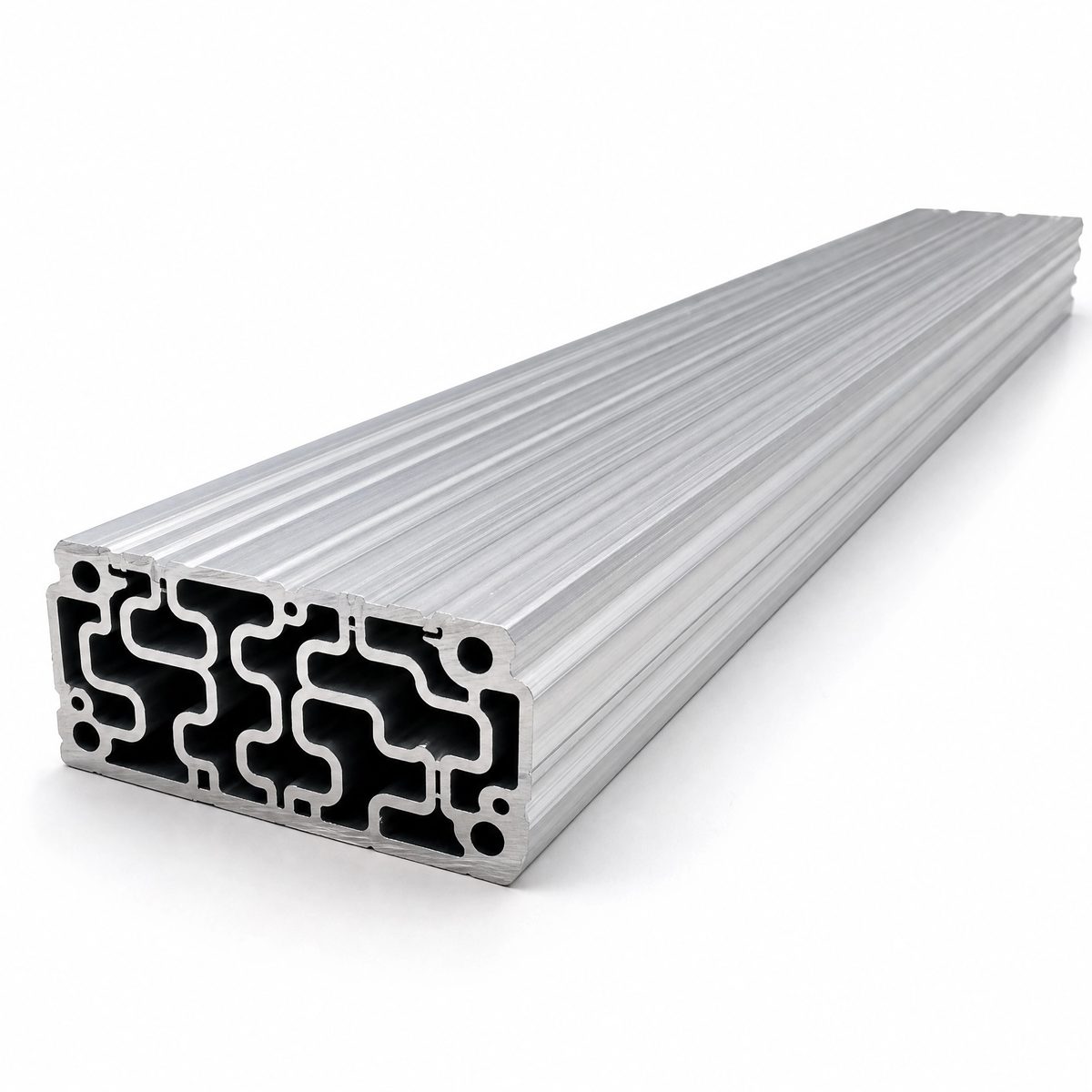
Aluminum profiles for radiators
Battery Liquid Cold Plate Aluminum Profiles
Battery liquid cold plates with extruded channels, 0.1 mm per meter flatness, 3003 or 6061, single lengths to 20 m. Uniformity and tolerances per drawing.
Produktdetails
Kurze Antwort: a battery liquid cold plate is an extruded aluminum plate with the coolant channels formed into the section, mounted against the bottom or side of the module. The number that governs the design is not the peak temperature but the spread across the pack: cells that run at different temperatures age at different rates, and a pack that diverges charges and discharges unevenly. We hold surface flatness at ≤ 0.1 mm/m to keep the thermal pad in contact, run 3003 or 6061 depending on whether corrosion or strength is the governing risk, and extrude in single lengths up to 20 m to remove splices. Flatness and channel geometry are confirmed against your drawing.
Why the temperature spread matters more than the peak
It is tempting to treat battery cooling as a matter of keeping the pack below a maximum. That is the wrong target, and it leads to designs that pass a peak-temperature test and still fail in the field. What degrades a pack is the difference between its hottest and coldest cell, because lithium cells age as a function of temperature and time together. A cell running five degrees warmer than its neighbor loses capacity faster, its internal resistance rises faster, and the pack management system has to work around an increasingly unequal set of cells.
The consequence shows up as a charging problem before it shows up as a safety problem. The BMS limits charge current to protect the weakest cell, so the pack charges slower than its specification even though the cooling system is technically working. Over time the imbalance grows, because the warmer cells degrade faster and get warmer still. The runaway case is the extreme end of the same mechanism, not a separate failure mode.
This is why a cold plate is specified by temperature uniformity across the contact area, not by total heat removal. A plate that removes a lot of heat from one end of the pack and little from the other meets a power target while failing the actual requirement. Channel layout, flow direction and plate flatness all exist to serve uniformity, and each of them can undermine it independently.
Spezifikationen
| Element | Bereich |
|---|---|
| Construction | Extruded aluminum plate with integrally formed coolant channels, no welded channel seams |
| Cell temperature spread | Designed to hold within ±2 °C across the contacted area, subject to pack layout and flow rate |
| Alloy thermal conductivity | 201–237 W/m·K depending on alloy |
| Legierungen | 3003 for corrosion resistance, 6063 for formability, 6061 for strength |
| Surface flatness | Reference ≤ 0.1 mm per meter |
| Single extrusion length | Up to 20 m, reducing splice joints |
| Channel structures | Multi-channel parallel, serpentine, or as drawn |
| Density advantage | Aluminum at roughly one third the density of steel |
| Oberflächenbehandlung | Anodizing or passivation for coolant-side corrosion resistance |
| Welding compatibility | Friction stir welding for splicing plates and attaching inlet and outlet ports |
| Deep processing | CNC milling, drilling and tapping, precision cut to length, ready for pack assembly |
Flatness, and the air gap that costs more than the plate
A cold plate does not touch the cell. It touches a thermal pad, and the pad touches the cell. That pad is the largest single thermal resistance between the cell and the coolant, and its thickness is set by how flat the plate is.
The reason is that air is effectively an insulator: its thermal conductivity is around 0.026 W/m·K, roughly one eight-thousandth of aluminum. Any gap that is not filled with pad is filled with air, and a small air layer dominates the thermal path no matter how thick the aluminum is. A plate at 0.1 mm per meter keeps the pad compressed to a thin, even layer. A plate that is bowed forces the pad to bridge the gap over part of the area while being over-compressed somewhere else, which is the worst of both: high resistance where the gap is, and possible pad damage where the plate presses hardest.
Over-compression is the failure that gets discovered late. A pad compressed beyond its rated range loses resilience, and after a few hundred thermal cycles it takes a permanent set and stops recovering, so the contact degrades even though nothing moved. This is why the flatness figure is specified on the mounting face and why the datum is stated on the drawing: it is not a machining tolerance, it is a condition for the thermal interface to work at all.
3003 or 6061: the choice follows the failure you are guarding against
The alloy decision is usually made on strength when it should be made on which failure mode is most likely.
- 3003. Manganese-alloyed, with thermal conductivity around 201 W/m·K and notably good corrosion resistance. The internal surface of a cold plate is wet for its whole life, so corrosion resistance protects the function that matters most. 3003 is the usual choice where the plate is a thermal component and the structure is carried elsewhere.
- 6061. Higher strength, heat-treatable, and the right answer when the plate is also a structural member or carries the module in bending. Its copper content makes it less corrosion-resistant than 3003 internally, so the surface treatment matters more.
- 6063. Good extrusion formability, which matters for complex channel sections, with thermal conductivity in the same range.
The practical rule: if the plate is purely thermal and the pack frame carries the load, use 3003 and put the effort into the surface treatment. If the plate is part of the structure, use 6061 and accept that the internal protection has to be specified rather than assumed.
Why length matters, and where friction stir welding comes in
A single extrusion up to 20 meters means one plate can span a module without a joint. Every splice in a coolant path is a potential leak, and in a battery pack a leak is not a maintenance item, it is a safety event: coolant contacting a high-voltage enclosure is exactly the scenario the pack design is trying to exclude. Fewer splices is therefore a reliability decision, not a logistics convenience.
Some joints are unavoidable: inlet and outlet ports have to be attached, and very long packs may still need plates joined end to end. Friction stir welding is the method that suits this material. It is a solid-state process, so the metal does not melt, which means no porosity, no hot cracking and no loss of the temper in the way fusion welding causes. The joint retains more of the parent metal's strength and, critically for a coolant path, it is far less likely to contain the microscopic voids that start a weep.
Wo dies passt
- Traction battery packs in electric vehicles, where cell-to-cell uniformity drives both range retention and charge time
- Stationary energy storage racks, where the pack is expected to hold its capacity for a decade of daily cycling
- Fast-charging packs, where the heat load during charge is the design case rather than the drive cycle
- Pack architectures where the plate also has to be thin, because ground clearance or pack height is fixed
- Modules that will be joined into a larger pack, where friction stir welding allows a continuous coolant path
Wo es nicht passt
- Packs with a very small production volume, where the die cost dominates and a machined or welded plate is more sensible.
- Flow paths that must turn within the plate, since an extruded channel runs straight along the section.
- Applications where the coolant chemistry is incompatible with aluminum regardless of coating.
- Cases where the pack is air-cooled by design and adding a wet loop introduces more risk than it removes.
Was für ein Angebot zu senden ist
- The module footprint, mounting points and the cell format, so the contact area is defined
- The heat load in the worst case, which for most packs is fast charge rather than continuous discharge
- The coolant, its inlet temperature and the available flow rate
- The uniformity target across the pack, stated as a temperature spread
- Whether the plate is structural, which decides the alloy
- The flatness and the datum face, and the pad type if it is already chosen
- Quantity and the required single length, checked against the 20 m extrusion limit
If the pack layout is not fixed, send the cell arrangement and the heat load. Channel layout and section can be proposed from that, and the uniformity estimate comes with it.
FAQ
What flatness can you hold, and what tolerance on the channels?
As a reference, surface flatness ≤ 0.1 mm per meter on the cell contact face. Channel geometry follows the die and the drawing, with the achievable band confirmed once the section is defined. Both figures depend on section width, wall thickness and how the plate is supported after machining, so the confirmable number is specific to your part. The value on your order is set by your drawing. We state it before production, and if the uniformity target requires tighter flatness than the section allows, that shows up at that stage rather than at first article.
How do you control the temperature spread across the pack?
Three things, and they have to agree: the channel layout has to deliver roughly equal flow to every region, the plate has to be flat enough that the thermal pad contacts evenly, and the flow direction has to be chosen so the coolant does not enter cold at one end and leave warm at the other across a long span. A serpentine layout trades pressure drop for residence time; a parallel layout reduces pressure drop but depends on a well-designed inlet manifold. The layout is chosen against the pack geometry, not by default.
Can the plate be welded into the pack?
Yes, and friction stir welding is the suitable method for splicing plates and attaching ports. It is a solid-state process, so there is no porosity or hot cracking at the joint, which matters on a coolant boundary. Fusion welding is possible but leaves more risk in a path that must not weep.
Does the coolant corrode the aluminum?
It will, if the surface is untreated. Anodizing or passivation on the coolant side is what makes a long service life realistic. Which treatment depends on the coolant chemistry: glycol-based fluids with the correct inhibitor package behave very differently from water with high chloride content. Tell us the coolant and the treatment is chosen for it.
What is the longest plate in one piece?
Up to 20 m of extrusion. In practice the limit for a finished plate is usually handling and transport rather than the press, so long packs are often split into shipping lengths with the joint placed where the pack structure already needs one.
Can you deliver ready for pack assembly?
Yes. Extrusion, CNC milling, drilling and tapping, precision cutting and surface treatment are done in sequence without transferring the part between suppliers, so the plate arrives at the assembly line finished rather than as a semi-finished section that still needs three operations.
Senden Sie Ihre Zeichnung
Email linjunbing@truetrustlv.com with the module footprint, the heat load and the coolant conditions. If the pack layout is still open, send the cell arrangement and the uniformity target. You will get a process proposal, a quotation and the flatness we can hold — reviewed by an engineer, not an auto-reply.
WhatsApp: +86 136 6644 0600
ANGEBOT ERHALTEN
Sobald Sie Ihre Anforderungen übermittelt haben, kontaktieren wir Sie so schnell wie möglich bezüglich Ihrer Produktanfrage.:Battery Liquid Cold Plate Aluminum Profiles